Can you really make money sports betting on low-risk, high-probability events?

Topics covered include:
- The growing size and influence of the U.S. sports betting market
- Recent sports betting scandals
- How sports betting odds work
- An intriguing low-risk approach to sports betting
- Why the low-risk sports betting approach is still gambling with a negative expected return
- Behavioral biases that encourage sports betting
- Revisiting the difference between investing, speculating, and gambling
Show Notes
How Do Betting Odds Work? by OC Staff—oddschecker
Senate Commerce Committee Wants Answers on NBA Gambling Scandal—Senate Commerce Committee
ESPN Will Not Let Failure Push It Out Of The Gambling Business by Chris Thompson—Defector
How sports gambling took over prediction markets in the US by Sam Learner, Oliver Roeder and George Steer—The Financial Times
Episode Sponsors
Delete Me – Use code David20 to get 20% off
Become a Better Investor With Our Investing Checklist
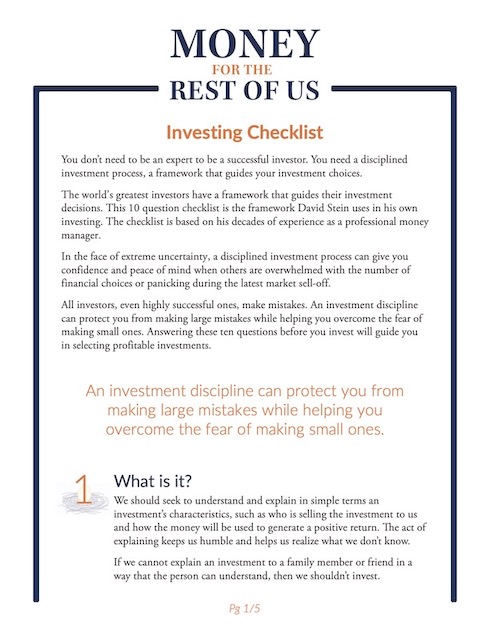
Become a Better Investor With Our Investing Checklist
Master successful investing with our Checklist and get expert weekly insights to help you build your wealth with confidence.
Related Episodes
491: The Five Layers of Investing
486: How Retail Traders Lose Big While Enriching Wall Street
Transcript
Welcome to Money for the Rest of Us. This is a personal finance show on money, how it works, how to invest it, and how to live without worrying about it. I’m your host, David Stein. Today is episode 544. It’s titled “Sports Betting Is Not Investing.”
Sports Betting Growth
Sports betting has gone from something taboo to mainstream in only six years, after the U.S. Supreme Court in 2018 struck down the Professional and Amateur Sports Protection Act. That act effectively banned sports betting in the U.S. since 1992. But now, sports betting is legal in the U.S, has been since then.
In 2019, the revenue from sports betting was less than $1 billion. Last year, it was close to $14 billion. And it’s everywhere. There are ads everywhere. It’s fully integrated into ESPN, Disney. Prediction markets such as Polymarket and Kalshi have adopted sports betting. In the case of Kalshi, they just introduced it this year, and it’s by far the largest aspect of their business.
Low Stress Sports Gambling
Now, I’ve talked about this before, but I got an email this week that intrigued me. I get dozens and dozens of pitches each week about being a guest on Money for the Rest of Us. And as you know, we rarely have interviews, but this one intrigued me.
I’m not going to use the individual’s name, nor his platform, because I want to protect his
So I get this email, and this individual mentions how Money for the Rest of Us teaches investing principles. And he says he thinks that our audience, you, would appreciate his sports betting approach, applying proven investment strategies to sports betting, and making healthy returns with lower risk.
His approach is to help people treat sports bets as a portfolio, using behavioral finance and a margin of safety to guide decisions, very much in the spirit of Warren Buffett and Charlie Munger’s philosophy. Now, that is a great pitch, at least to me, given my approach.
Is it possible? This individual shared his statistics for the 2024-2025 NFL season. He earned a 15.2% return on investment, close to 15% in the 2025 PGA season. He’s beaten the S&P 500 index 7 out of 12 months, stayed profitable 9 out of 12 months, and he has a free newsletter where he shares his bets. I replied that I would check out the newsletter, and I signed up. And I got the first bet. It was for a Pittsburgh Penguins game. And I thought, “Well, I’ll see if it works out.” And I’ll share what happened here in a bit.
As a Money For the Rest of Us Plus member, you are able to listen to the podcast in an ad-free format and have access to the written transcript for each week’s episode. For listeners with hearing or other impairments that would like access to transcripts please send an email to team@moneyfortherestofus.com Learn More About Plus Membership »
