David converses with best-selling author David Bach about preventing burnout through sabbaticals, moving to another country, why retirees should take Social Security as early as possible, and Bach’s idea of a flat tax on IRA distributions.

Show Notes
David Bach’s IRA Flat Tax Idea
Become a Better Investor With Our Investing Checklist
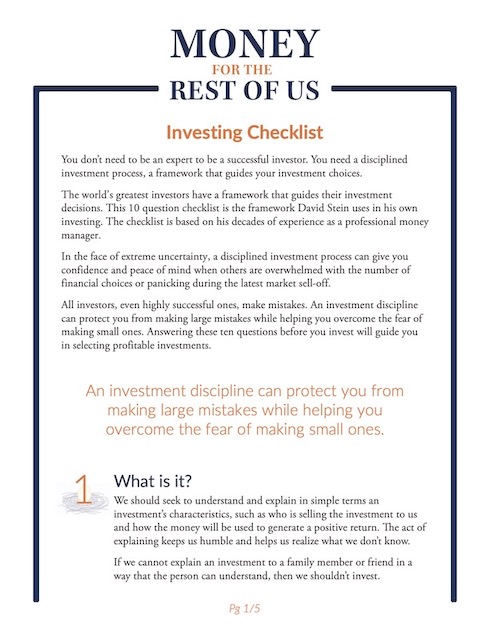
Become a Better Investor With Our Investing Checklist
Master successful investing with our Checklist and get expert weekly insights to help you build your wealth with confidence.
Related Episodes
506: Should You Retire Early and Live Outside Your Home Country? With Joshua Sheets
Transcript
Welcome to Money for the Rest of Us. This is a personal finance show on money, how it works, how to invest it, and how to live without worrying about it. I’m your host, David Stein. Today is episode 545. It’s titled “Burnout Breaks and the Courage to Spend, with David Bach.”
This week on the show, I visit with David Bach, a former financial advisor and the author of 12 national best-selling books with more than 7 million copies sold, including The Automatic Millionaire, which is being re-released in a 20th anniversary hardcover edition.
David shares how, at age 9, he was attending his father’s investment classes, and by 13, he was teaching his friend’s parents about municipal bonds. We discuss David’s advisory career, and what led to his first book, Smart Women Finish Rich, and how, at age 46, burned out and exhausted, he took a mini-sabbatical that helped him reset his work and his life.
We also talk about why he and his family moved to Florence, Italy, when David was 53. They only planned to stay 9 months, and 6 years later, they’re still there. What’s intriguing about this episode is that while David is known for saving early and often, most of our conversation revolves around not being afraid to spend.
Spend the money to take a mini-retirement or sabbatical. Spend the money by taking Social Security at age 62, instead of waiting. We even discuss David’s proposal for a 12% flat tax on retirement distributions, something I didn’t necessarily agree with, as you’ll hear in this episode. I hope you enjoy this conversation I recorded earlier this week with David Bach.
David Stein: Well, David, thank you for joining Money for the Rest of Us. Your book, The Automatic Millionaire—it’s been 20 years, and I’ll admit, I haven’t read the book, but I’ve looked at it dozens and dozens of times, because it came out in 2004. The title was always attractive. At the time, I was an institutional investment advisor, spending a lot of time in the airport, but the cover of two empty beach chairs—I assume they’re in the beautiful Caribbean, but it always called to me. It’s like “Yes, that’s the goal, to be on the beach.”
David Bach: “That’s what I want.”
David Stein: Exactly. So as part of that, then, I did read part of the 20th anniversary, and I learned something that—in the back, you have a new Q&A section, which was pretty fascinating to me. In that—well, let’s talk about that, because I did not realize that your father was a financial advisor. You worked with him for 10 years. Where was the Bach Group located?
David Bach: Yeah, so the Bach Group was located in Morgan Stanley. I mean, I know you have your whole family in the business.
I just got to meet your son, who’s working backstage here with us virtually. I started going to my dad’s investment classes at the age of nine. So my father was a financial advisor. Back in the day, they called them stockbrokers. My dad worked at a company called J. Barth & Company. My dad built his business teaching investment classes. So he taught retirement planning classes in the Bay Area. We lived in San Francisco, in the Bay Area.
David Stein: Oh, you were in the Bay Area. Okay.
David Bach: So he taught these classes in the East Bay. Mom would dress me up at nine years old in a suit and tie, she would get the night off, dad would take me to the investment class. I would sit there for two hours, be a good boy, listen to him teach, and I would hand out the flyers, the worksheets in the front of the class. And you sit in the back of the room at nine years old, and then we’d go to dinner, and we’d talk about what he taught.
So by the time I was 13 years old, I was teaching my friends’ parents why they should be buying municipal bonds and not CDs. I was literally sitting at my friend’s house, and the mom is renewing a CD, and I’m like, “Mr. and Mrs. Jones, you shouldn’t be buying CDs. Those stand for certificates of depreciation. Right now, you can be buying a AAA-rated municipal bond in California, and in your tax bracket, that would be a tax-equivalent yield of.” And they would just look at me like “Wait, who brought this kid? Who is this kid?”
So I grew up in a very—it’s a very different way to grow up, but I was lucky, because we talked about investing at the dinner table. And so I always say—The Automatic Millionaire, I’ve got 7 million books out around the world, but the Automatic Millionaire was my most popular book.
It’s a book I launched on Oprah 20 years ago. And at the end of the first show, Oprah turned to me, and she’s like “They should teach this stuff in school.” And I said, “Oprah, I know.” I said, “What’s tragic, honestly, about The Automatic Millionaire“, which has sold over 2 million copies now, and it’s coming out as a hardcover, a 20-year anniversary edition, “no one should need this book.” This book should have been taught to you. Everything inside The Automatic Millionaire—you should have learned the basics of financial planning before you graduated high school.
And they don’t teach this in school, and so people are basically set up for failure, financially. And you and I, we come from the industry, but if you don’t grow up with this stuff, you go off to school, you get credit cards, you get in credit card debt, you borrow money for college, and you start off in a hole, and you don’t even know how to get out of the hole, much less know how to save and invest for retirement.
So the system’s kind of rigged. And what I’ve spent the last 30 years doing, besides being in financial services—because the Bach Group was in Morgan Stanley. When I retired from Morgan Stanley in 2001, I basically dedicated my life to teaching people to be smarter with their money. I decided to go out and help millions of people instead of work with 100 really wealthy clients. I just felt like my life—I was supposed to do more than just work with 50 to 100 high-net-worth individuals. And I’m actually still doing it. I’m still teaching people about money.
David Stein: So on that—so you were probably early to mid 30s. It mentioned in the back of the book that you moved, I guess, from the Bay Area to New York City.
As a Money For the Rest of Us Plus member, you are able to listen to the podcast in an ad-free format and have access to the written transcript for each week’s episode. For listeners with hearing or other impairments that would like access to transcripts please send an email to team@moneyfortherestofus.com Learn More About Plus Membership »
