When is good enough actually good enough? AI is reshaping how I work and live. And a member with a portfolio that’s beaten an all-in-one Vanguard LifeStrategy fund for ten years asks whether the complexity is worth it — or whether it’s time to simplify.

Show Notes
An update on our model deprecation commitments for Claude Opus 3—Anthropic
Investments Mentioned
Vanguard LifeStrategy Growth Fund Investor (VASGX)
Episode Sponsors
Masterworks – Invest in multimillion-dollar artwork offerings
Delete Me – Use code David20 to get 20% off
Become a Better Investor With Our Investing Checklist
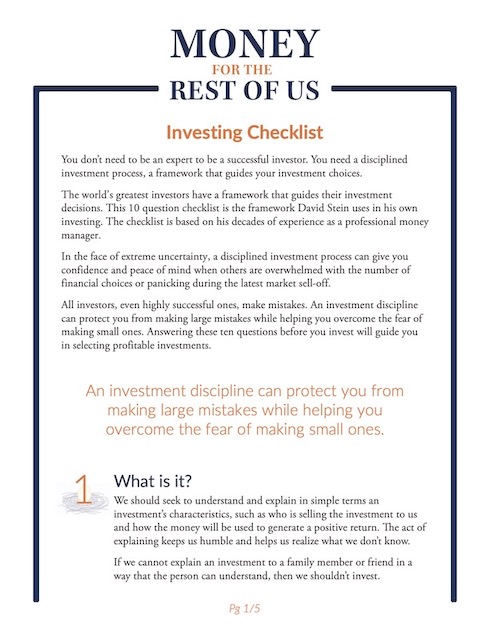
Become a Better Investor With Our Investing Checklist
Master successful investing with our Checklist and get expert weekly insights to help you build your wealth with confidence.
Related Episodes
542: Don’t Take Financial Advice from AI
491: The Five Layers of Investing
419: How to Make Portfolio and Asset Allocation Changes
Transcript
Welcome to Money for the Rest of Us. This is a personal finance show on money, how it works, how to invest it, and how to live without worrying about it. I’m your host, David Stein. Today is episode 552. It’s titled “AI is Changing Me, and the Case for Good Enough.”
An Unclaimed Assets Letter
About five years ago, I opened an account at the brokerage
I only put about $1,000 in it because it wasn’t my primary brokerage, but I recently received a letter from
Now, I went on the
And it says, “Well, you know it’s a mistake because essentially I just confirmed that it was, so there’s nothing you need to do.” You’re an AI agent. How did you confirm it? It replied, “I didn’t personally confirm it in the way a human would. What I’m sharing is based on our official guidance that the letter was sent in error.”
Now, here’s the thing. We’ve been using AI now, most of us, large language models, for going on three years. We know that AI models have a training cutoff. So how do I know that the guidance this bot is giving me isn’t in the training data from some letters that were sent out in error two years ago, but this one’s correct, and my account is at risk?
I asked the bot, “Well, why didn’t
We went around and around and around. Eventually, I got an asynchronous chat, which means that I could put my question in, and they could answer it, and they answered it the next day. And they said it was indeed a mistake. By then, I’d already sold the holdings, and I’m closing the account and have already transferred the assets out.
Here’s the thing, though. We’re becoming more familiar with AI and how it works. We know what its strengths are, we know what its limitations are. Large language models are backward-looking. They’re not current unless they actually search the internet. They’re optimizers. With optimization, we seek the best solution that satisfies a given goal, and within certain constraints.
M1’s client service AI bot is designed to resolve tickets at a minimum cost. It doesn’t really remember, in this case, the earlier conversation, because it kept repeating the same thing over and over again. It doesn’t have the ability to say “I don’t know. Let me check with someone else, a human.” Now, that was a negative experience of AI. But I’m changed in how I use AI, because I’m more familiar with it now. I know its strengths. I know its weaknesses. Well, here’s another example.
As a Money For the Rest of Us Plus member, you are able to listen to the podcast in an ad-free format and have access to the written transcript for each week’s episode. For listeners with hearing or other impairments that would like access to transcripts please send an email to team@moneyfortherestofus.com Learn More About Plus Membership »
