How historical and expected returns for university endowments can guide us in setting reasonable return expectations. We also analyze managed futures strategies to see how they work, how they have performed, and how to use them in your investment portfolio.

Show Notes
2025 NACUBO-Commonfund Study of Endowments (NCSE) Results—NACUBO
Princeton University cuts expectation for endowment returns by Sun Yu—The Financial Times
Demystifying Managed Futures by Brian K. Hurst, Yao Hua Ooi, and Lasse H. Pedersen—AQR
Investments Mentioned
AQR Managed Futures Strategy Fund I (AQMIX)
iMGP DBi Managed Futures Strategy ETF (DBMF)
KraneShares Mount Lucas Managed Futures Index Strategy ETF (KMLM)
WisdomTree Managed Futures Strategy Fund (WTMF)
First Trust Managed Futures Strategy Fund (FMF)
Return Stacked US Stocks & Managed Futures ETF (RSST)
Episode Sponsors
Delete Me – Use code David20 to get 20% off
Become a Better Investor With Our Investing Checklist
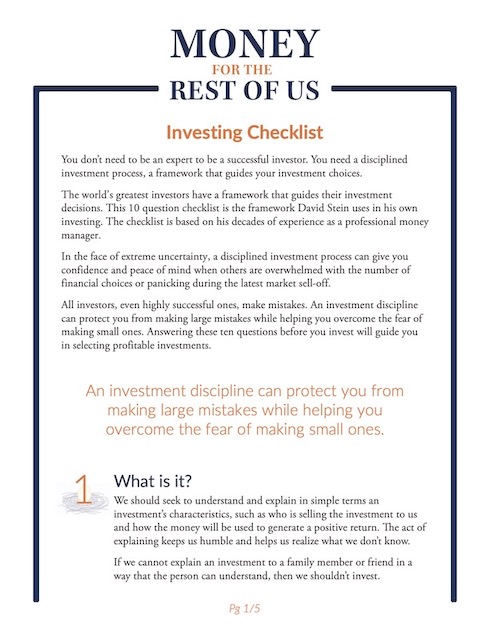
Become a Better Investor With Our Investing Checklist
Master successful investing with our Checklist and get expert weekly insights to help you build your wealth with confidence.
Related Episodes
524: Facing a Financial Squeeze: What Harvard’s Response Can Teach the Rest of Us
204: Why Are Investment Returns So Low?
180: Can You Outperform Harvard’s Endowment?
Transcript
Preview
In this episode of Money for the Rest of Us, we take a look at a strategy that actually added value in 2022. In some cases, 30% plus returns in a time when the stock market fell off, when bonds sold off. It’s called managed futures. In the second part of the podcast, we take a deep dive into how they work and how you could use them in your portfolio.
In the first part of the podcast, we take a look at why university endowment returns have been so essentially subpar over the past 20 to 25 years. I hope you’ll stick around, listen to this episode, episode 551. And also, if you find it helpful, please share this episode with your friends and family. Just text it to them and share the word about Money for the Rest of Us. Now, on to the episode.
Welcome to Money for the Rest of Us. This is a personal finance show on money, how it works, how to invest it, and how to live without worrying about it. I’m your host, David Stein. Today is episode 551. It’s titled “What Average Really Looks Like, and Can Managed Futures Help?”
Long-term University Endowment Investment Performance
This month, February 2026, the 2025 NACUBO-Commonfund Study of Endowments was released. This is a compilation of hundreds and hundreds of university endowments in the U.S. as they report their investment performance, their asset allocation, their spending rate, and lots of other data as it relates to managing these investment portfolios that help fund university operations.
I always looked forward to that study when I was an institutional investment advisor consultant, as I had a number of university clients, including Texas A&M University, University of Puget Sound, for a while, Texas Tech, and others. And so I looked at this study, and this is what stood out to me. Performance. Pretty ho-hum. If we go back 25 years—so this study ends June 2025. We’ll go back to June 2000 and look at the 25-year annualized return for the average university endowment. I mean, some did worse. Some, of course, did better. The average 6.6% annualized. For the 20-year period. So from June 2005, through June 2025, 7.3% annualized.
These are not double-digit returns. These are mid-to-upper single digits. These are university endowments that have very skilled staff, they have sophisticated investment committee members, board members, they have access to the best of the best when it comes to investment strategies, hedge funds, private capital.
And yet, despite all that, they returned 6-7% annualized over the past 20-25 years. Do you find that disappointing? I find it math. The fact that starting valuations matter. When we look at how the stock market, U.S., and global stocks were valued in June 2005, that makes a difference in terms of the return over decades. What bond yields were, the starting bond yields—that makes a difference.
If we look at the price-to-earnings ratio of U.S. stocks back in June 2000, they were at 28.5, About what they are today. Investors were paying $28 for a dollar worth of earnings. In June 2005, U.S. stocks were priced at a P-E ratio of 18.5, versus 28 today. So the starting valuations were lower back in June 2005.
Yet, if we look at the annualized return of the average university endowment over the past 20 years, only 7.3%. If we consider bond yields, in June 2000, the U.S. Aggregate Bond Index its yield to maturity was 7.2%. It’s 4.4% today. That means lower expected bond returns as we look out in the decade or so ahead. Back in June 2005, the yield to maturity on the U.S. Aggregate Bond Index was 4.5%. So just slightly above today.
Here we have starting conditions not that different than 2005 or 2000, depending on what we measure. And then, again, if we look at their returns, the average endowment, 6% to 7%—shouldn’t that be our expectation, if we’re modeling out our portfolio returns, what we might put into a retirement planning calculator for what we think we can earn over the next decade or two? That’s certainly what we’re assuming. If we look at our model portfolios on Money for the Rest of Us Plus, our expected return for a moderate to aggressive portfolio is kind of 6% to 6.4%, with a probable range of 3% to 9%. So kind of right in there.
Now, this is the average return. If we look at expectations, the average target return for a university endowment is 7.3%. So kind of right around in that 6% to 7% range. And they come up with that based on what they expect to spend. On average, it’s 4.9%. And a university endowment wants to earn enough so that the endowment is at least staying even on an inflation-adjusted basis. So, if we look at that, they’re basically assuming an inflation rate of 2.4% over whatever timeframe they’re modeling. That seems reasonable, but that’s kind of how they come up with that.
As a Money For the Rest of Us Plus member, you are able to listen to the podcast in an ad-free format and have access to the written transcript for each week’s episode. For listeners with hearing or other impairments that would like access to transcripts please send an email to team@moneyfortherestofus.com Learn More About Plus Membership »
