Our view of the world dictates how we should and should not invest.

In this episode you’ll learn:
- Why financial markets are getting more risky and unpredictable.
- Why the economy and financial markets are not simple machines that can be controlled.
- How to invest in a ceaselessly creative, radically unpredictable world.
- Why we could be experiencing a regime when it comes to indexing and ETFs that might mean using non-indexing strategies.
Show Notes
Uncertainty – Lawrence M. Krauss – Edge
Regression To the Mean – James J. O’Donnell – Edge
Excerpts from Seth Klarman’s 2016 year end letter to his clients as quoted in the New York Times
Messy: The Power of Disorder To Transform Our Lives – Tim Harford
Seth Godin Course on Presenting To Persuade
Ultra-Easy Money: Digging The Hole Deeper? – William R. White
Become a Better Investor With Our Investing Checklist
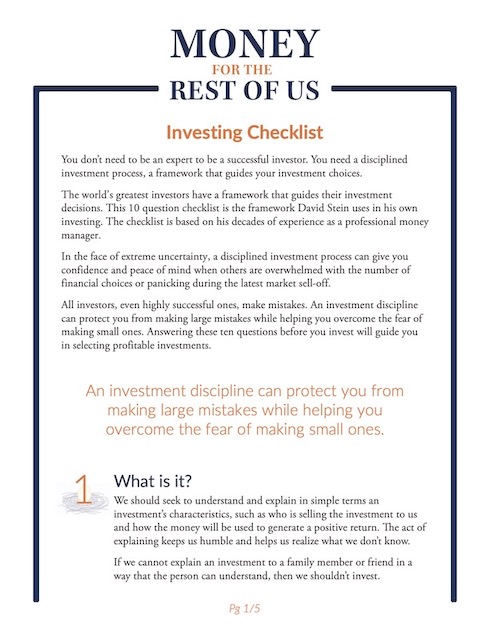
Become a Better Investor With Our Investing Checklist
Master successful investing with our Checklist and get expert weekly insights to help you build your wealth with confidence.
Summary Article
Most Days Are Average
A few weeks ago, LaPriel and I awoke before dawn by a sound in our bedroom. We were staying in an Airbnb rental in Merida, Yucatan. We listened and it sounded like some kind of rodent in the room. It was scratching, and we could hear what we thought was debris falling onto the floor.
I turned on the flashlight on my iPhone and looked around, but didn’t see anything. Neither of us dared get out of bed. We are like that when it comes to rodents.
We laid back down and a few minutes later the sound continued. This time I got up but still couldn’t find anything, and then the sound stopped altogether.
Later when it was light, I examined the shelves where the television was in the room and the floor around it. Sure enough there were cement chips and dust from the wall that must have fallen as the rat scraped at it in the night. I could see where the rat had been digging on the wall by the shelf near where a cable came through.
I texted the owner and told her I thought there might be rats in the house and why.
Confirmation Bias and the Availability Heuristic
I have lived in houses in Mexico with rats. I was once woken in the middle of the night in Chiapas when our kitten fought with a rat that was equal to it in size.
We dealt periodically with mice at our farm house.
Consequently, when I hear sounds in the night my availability heuristic kicks in and my first thought is a mouse or a rat has invaded the house.
Then in the morning I look for evidence such as mouse droppings or cement debris on the floor to confirm my suspicion. That is my confirmation bias working hard.
There wasn’t a rat in the bedroom. The owner said the cable guy was in the house the day before fixing the Internet and must have left debris on the floor. She also said there is an opossum that likes to climb on the roof to better reach leaves on a nearby tree. She suggested that is what we most likely heard, and with the the bedroom air conditioner running it would be difficult to determine where the opossum sounds were coming from.
Her explanation makes more sense than ours. Especially since the owner is very particular about her house and extremely squeamish when it comes to rodents and bugs.
Regression To The Mean
Physicist Lawrence Krauss related how fellow physicist Richard Feynman was fond of saying to people, “You won’t believe what happened to me today!” and then he would add “Absolutely nothing!”
Most days are boring. Surprises and outliers are rare. And often what we think are rare, unlikely or unusual events such as rats eating cement in the bedroom turn out to have very logical explanations.
Classical scholar James J. O’Donnell discussed this idea, which is known as regression to the mean, in an essay for Edge. He wrote regression to the mean is a “concept from the discipline of statistics, but in real life it means that anomalies are anomalies, coincidences happen (all the time, with stunning frequency), and the main thing they tell us is that the next thing to happen is very likely to be a lot more boring, ordinary, and predictable. Put in the simplest human terms, it teaches us not to be so excitable, not to be so worried, not to be so excited: Life really will be, for the most part, boring and predictable.”
Fearing the Unpredictable
I received an email the other day from Doug who wrote how he woke up in the middle of the night with a sudden urge to sell all of his investments and move to cash. He has over forty years of investing experience and has never felt that way.
He is not yet 65, retired with no pension so he lives on the income generated from his investment portfolio.
His concern was driven by the actions of President Trump. He wrote, “I agree with you that the President doesn’t have much direct power over the economy. He can “tweet” all he wants, but he can’t change the direction of the global economy by edict. However, he can create an environment of uncertainty that can enable events that elevate risk,” and that “can have a huge and unpredictable effect on the economy.”
One of my virtual investment mentors Seth Klarman of the Baupost Group addressed this in his annual letter to his hedge fund clients that was quoted in the New York Times, “The big picture for investors is this: Trump is high volatility, and investors generally abhor volatility and shun uncertainty. Not only is Trump shockingly unpredictable, he’s apparently deliberately so; he says it’s part of his plan.”
Tim Harford in his book, “Messy: The Power of Disorder To Transform Our Lives” suggests Trump deliberately deploys chaos as a competitive weapon.
Harford wrote, “If you could disorient your opponent, forcing him to stop and figure out what was going on, you gained an advantage. And if you could do this relentlessly, your opponent would be paralyzed with confusion.”
My listener Doug continued in his email regarding his impulse to sell all of his investments, “I actually had to discuss this with friends the next day because I was at least smart enough to realize deep down it was emotional and not necessary rational. But there is a rational aspect to it in the sense that unpredictable things can really happen and it is rational to be concerned about [them]”.
Striking the Right Balance
Investing requires balance. It is rational to be concerned and be prepared for unpredictable, extreme events that could impact our investment portfolio.
Preparation means having some of our assets invested outside of publicly-traded securities, be it real estate, land, gold, food storage, our own education etc.
At the same time, most days are unremarkable with financial markets returning close to their average daily return.
If we fear and focus too much on extreme events, we are likely to make investment decisions based on emotion rather than following a disciplined investment plan that balances risks and rewards.
Since April 1, 2009 through February 14, 2017 global stocks have cumulatively returned 154% or 12.6% annualized as measured by the MSCI All Country World Index.
Some investors missed that entire move in stocks and stayed in cash because they were worried about the next market crash following the great financial crisis.
Transcript
Welcome to Money For the Rest of Us, a personal finance show on money, how it works, how to invest it, and how to live without worrying about it.
I’m your host, David Stein, and today is episode 145. It’s titled “People like us invest like this.”
Woken in the Night
A few weeks ago LaPriel and I awoke about 5 AM by a sound in our bedroom. We were staying in an Airbnb rental in Merida, Yucatan, Mexico.
We listened and it sounded like some kind of rodent in the room; is was scratching. We’d hear what we thought was debris falling onto the floor from the shelves where the television and some stereo equipment was.
I turned on the flashlight and shined it on the shelves, the flashlight on my iPhone. I looked around but didn’t see anything.
Neither of us dared to get out of bed because frankly, that’s kind of what we’re like when it comes to rodents. They’re not our favorites.
We laid back down and tried to ignore it, but a few minutes later the sound continued. This time I got up, but still couldn’t find anything, and after a few minutes, the sound stopped altogether.
Later in the morning when we woke for good and there was light, I examined the shelves where the television was, and the floor around it, and sure enough, there were cement chips and dust from the wall that must have fallen as the rat scraped at it in the night.
I could see where the rat had been digging into the wall because there was a cable coming out. It was kind of a big chunk. So I texted the owner and I told her I think there might be rats in the house.
I’ve lived in houses in Mexico with rats. I once woke up—we had rats in one house down in Chiapas, and the rats would come in through the window and grab bananas and jump back out.
We bought a kitten, and I was woken up in the middle of the night by this big fight between the rat and the kitten.
As a Money For the Rest of Us Plus member, you are able to listen to the podcast in an ad-free format and have access to the written transcript for each week’s episode. For listeners with hearing or other impairments that would like access to transcripts please send an email to jd@moneyfortherestofus.com Learn More About Plus Membership »
