Circle Invest, one of the leading stablecoin providers, just went public, and its stock price has tripled. We delve into the growth of stablecoins, their applications, and the associated risks. We also discuss the surprising political pushback against central bank digital currencies.
Show Notes
Top Stablecoin Tokens by Market Capitalization—CoinMarketCap
Amendment No. 3 to FORM S-1 REGISTRATION STATEMENT UNDER THE SECURITIES ACT OF 1933—SEC
Why Crypto Stablecoins Still Worry the Fed by Olga Kharif and Yueqi Yang—Bloomberg
Central Bank Digital Currency Tracker—Atlantic Council
STRENGTHENING AMERICAN LEADERSHIP IN DIGITAL FINANCIAL TECHNOLOGY—The White House
Episode Sponsors
Delete Me – Use code David20 to get 20% off
Become a Better Investor With Our Investing Checklist
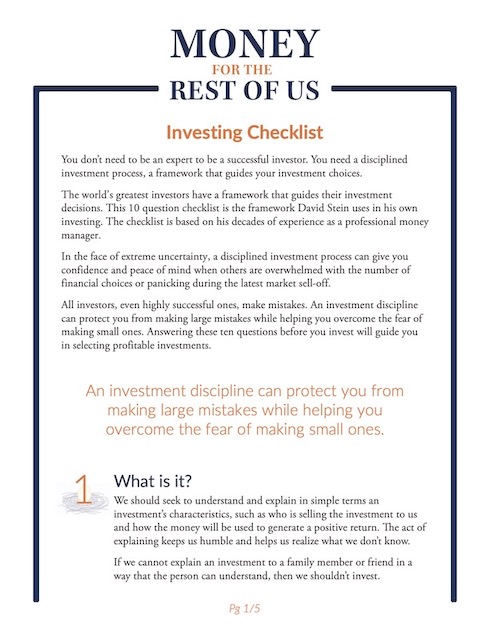
Become a Better Investor With Our Investing Checklist
Master successful investing with our Checklist and get expert weekly insights to help you build your wealth with confidence.
Related Episodes
488: Should You Invest in an Ethereum ETF?
424: Are More Bank Runs Coming? The Collapse of Silicon Valley Bank
373: Are Stablecoins Safe? Should You Own Them?
Transcript
Welcome to Money for the Rest of Us. This is a personal finance show on money, how it works, how to invest it, and how to live without worrying about it. I’m your host, David Stein. Today is episode 527. It’s titled “Stablecoins and CBDCs, Their Rise, Risks, and Possibilities.”
Circle IPO and USDC Overview
Last week, Circle Internet Group, ticker CRCL, conducted an initial public offering. Circle is the issuer of the USDC stablecoin with over $60 billion of USDC outstanding. The IPO price was $31 a share, and it has soared to over $100 per share.
It’s been about three years since we’ve taken a close look at stablecoins. In this episode, we want to understand how they have evolved, what’s their use case, what are their risks, and whether this is something we should even use.
Types of Money
As a review, let’s think about the different types of money. The first type of money we think about is currency. This is central bank money. The central bank can create money out of thin air. If you hold a US dollar bill, it says it’s a Federal Reserve note. It is issued by the Federal Reserve.
This is public money. We can use it anonymously in many cases, unless you’re trying to transport over $10,000 worth. But for smaller transactions, we can pay cash. It’s not tracked. Generally, we have that anonymity and it’s physical. We can hold these coins and bills.
There’s a second type of central bank money, though that’s digital. These are known as reserves. These are electronic deposits that commercial banks hold at the central bank, and these reserves are what are used to settle transactions between banks. These reserves can be created out of thin air as part of quantitative easing programs, and commercial banks earn interest on the reserves that are held at the central bank.
Now, as individuals right now, we don’t get access to central bank reserves, an electronic form of central bank money. Although in this episode, we’ll talk about how some central banks have issued what is known as central bank digital currencies, and it’s just like reserves that commercial banks have, but individuals can use this central bank digital currency to make payments.
In other places, such as the US, and we’ll talk about an executive order that came out from the Trump administration in January, as well as a House bill, there is severe resistance to the issuance of central bank digital currencies.
As a Money For the Rest of Us Plus member, you are able to listen to the podcast in an ad-free format and have access to the written transcript for each week’s episode. For listeners with hearing or other impairments that would like access to transcripts please send an email to team@moneyfortherestofus.com Learn More About Plus Membership »
