From salmon leaping along the Vancouver Island coast to fake bands on Spotify, this episode explores the divide between the physical and digital economy, and what lumber markets, managed forests, and everyday life teach us about staying connected to the real.

Topics covered include:
- How timber investing works and why it is reflective of how industries evolve
- What percent of economic output is physical versus digital, and how has that changed over the past fifty years
- How households spend their leisure time
- Why live events stand out in an AI-infested world
- Does it matter if ad images, videos, and podcasts are fake?
- Why we need to stay connected to the real
Show Notes
Lumber Price—Trading Economics
J.Crew used A.I. to counterfeit their own vibes—Blackbird Spylane
American Time Use Survey Summary—U.S. Bureau of Labor Statistics
Episode Sponsors
Claude.ai – Sign up for Claude today and get 50% off Claude Pro
Delete Me – Use code David20 to get 20% off
Become a Better Investor With Our Investing Checklist
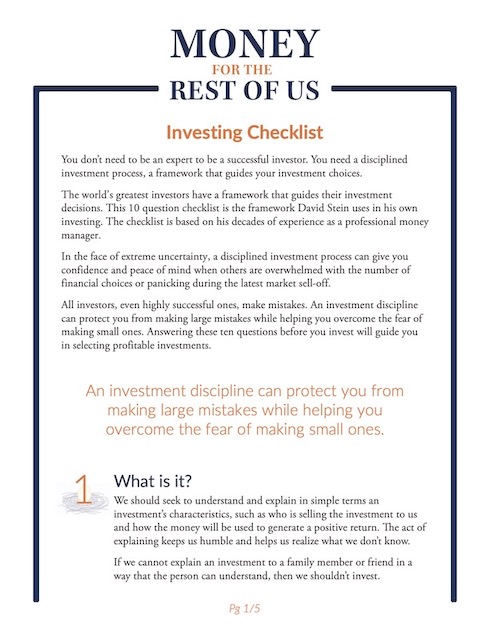
Become a Better Investor With Our Investing Checklist
Master successful investing with our Checklist and get expert weekly insights to help you build your wealth with confidence.
Related Episodes
535: Six Principles for Thriving Under Uncertainty and How Big Tech Is Doing the Opposite
531: Will AI Wipe Out Half of White Collar Jobs or Is There an AI Bubble?
60: Are You Hoarding Or Investing?
Transcript
Welcome to Money for the Rest of Us. This is a personal finance show on money, how it works, how to invest it, and how to live without worrying about it. I’m your host, David Stein. Today is episode 538. It’s titled “Forests, Fakes, and the Fight for the Real.”
Vancouver Island
LaPriel and I have spent the last couple of weeks exploring Vancouver Island. Last weekend, we were in the far north in the town of Port Hardy. Collectively, this year we’ve spent about six weeks in Canada; three weeks in Quebec in May, and this trip now.
I’ve never been to Port Hardy, and I saw some things there that I had never seen in my life. There were salmon jumping off the coast of Port Hardy as they were preparing to enter rivers to spawn, once there was enough rainfall to raise the flow in the river. I’ve seen trout jump, but I had never seen wild salmon jumping.
Near where the wild salmon were jumping, there was some clam beds, and the clams were squirting water, which—I had to ask one of the locals, what is that? And apparently, clams, when they sense some type of disturbance, or just part of their normal feeding activity, when they close their shells, that forces water out of their siphons that they use.
Also, this past weekend, LaPriel and I hiked this San Josef’s Bay Trail in Cape Scott Provincial Park. It’s about an hour and a half drive from Port Hardy, and it goes along these logging roads over the mountains. And the forests in that area are maintained and harvested by Western Forest Products, and their timber is primarily red and yellow cedar, Douglas fir, and hemlock.
Timber Investing
Western Forest Products is a publicly traded Canadian company. They say on the website they collaborate with over 50 First Nations in the coastal BC area as they work to advance sustainable forestry and provide career opportunities. They had signs on the road that showed when various trees were planted, when they had been thinned and fertilized, and the trees that they were harvesting have been planted back in 1950, so 75 years ago.
And it reminded me of the trip we took to Norway and Sweden just over 10 years ago, and there, they have a lot of spruce and pine forests. Most of those were managed by or owned by families, or 50% were owned by families, and they would harvest these trees after 75 years, and then they would plant new ones, which is what you do if you want sustainable forestry. But it’s a very long-time cycle. We don’t usually think about 75-year periods when it comes to investing.
I was curious in looking at Western Forest Products, how they’re doing financially. The tariff rate on cedar imports into the U.S. last year was 8%, and that was after it was increased. Now it’s 35%. There was an article recently in the Wall Street Journal that talked about how wood markets have been whipsawed by trade uncertainty.
Future prices for lumber—a thousand board feet I believe, is the measurement—right now it’s around $530 per thousand board feet. That’s down 24% from a three-year high this past August. We saw the price of timber jumped this year as businesses imported more of it, stockpiled it, not knowing what the tariff rate would be on Canadian timber imported into the U.S
It’s fascinating to look at a price chart of timber. Back in 2021, it got as high as $1,700 per thousand board feet. This is the future prices. Now it’s around $530. So you had a huge spike up due to the capacity constraints and all the building that was occurring coming out of the pandemic.
But long-term, when we look at “How have timber prices done? If you bought timber or invested in timber, how would you have performed?” Back in the early 2000s at my advisory firm, I was our timber analyst, as I was working several roles; one was as co-head of our private capital group as we were identifying managers within the private equity space, venture capital, buyout, and real assets.
And I took upon myself to learn timber investing, I visited a number of timber organizations, and I tried to understand this asset class. Which, in retrospect, has done okay. It’s returned, from what I could see, 7% to 8% annualized over the past 25 to 30 years. The primary measurement is the NCREIF Timber Index, and they seem to keep those returns hidden somewhere. So I couldn’t find up-to-date returns.
But in looking at the returns of timber REITs, for example—these are companies that invest in timber, manage timber—Weyerhaeuser is an example, PotlatchDeltic is another. If we look at their 15-year returns, around 7% annualized. Western Fortress Products hasn’t done as well. It’s returned about 5% annualized over the past 15 years, but part of that could be the currency conversion from the Canadian dollar to the US dollar.
If we look at how timber firms manage—how do they make money? What drives the return? Well, part of it’s the operating income. So it’d be timber harvest. As these trees grow over 75 years, they get bigger, and so their value increases, and so then after 75 years—for cedar and hemlock it could be 50 years—it’s harvested and you get operating income from that.
There’s also the value of the land. If the land is sold, the value of the land that has this timber increases, and then there’s higher and better use for land. Not so much, I think, in the area where we were, but it ultimately leads to a return stream; from the cashflow, from the value of land. About 7% to 8% annualized.
If we look at the actual price of timber though—and you have to be careful when you look at the price of a commodity, because it depends on where you start. You can start at the high, you can start at the low, and then take it out. But I went back to 1979, so it was around—that was sort of a high after the run-up of the 1970s. But timber was $250 for a thousand board feet. Now, as I mentioned, around $530. That’s 1.5% per year appreciation in the price of timber. Inflation over that time frame has been 2.9%.
So timber has not kept up with inflation over the past 55 years or so. And we think, “Well, why not?” Well, when you look at what drives the price of timber, clearly the demand for housing and other construction projects—the supply will impact that; supply and demand, as we would know. But also, how fast is the money supply increasing?
As a Money For the Rest of Us Plus member, you are able to listen to the podcast in an ad-free format and have access to the written transcript for each week’s episode. For listeners with hearing or other impairments that would like access to transcripts please send an email to team@moneyfortherestofus.com Learn More About Plus Membership »
