In this episode, we look at asset location, how to decide which investments belong in taxable, tax-deferred, and tax-free accounts, how where we live shapes the opportunities available to us, and how capital ultimately expands our choices.

Show Notes
The Hidden Healthcare Infrastructure Americans Cross the Border to Find—Kogod School of Business
Location as an Asset by Adrien Bilal and Esteban Rossi-Hansberg—Princeton
The Overlooked Edge: The Case for Asset Location in Managed Portfolios—Morningstar
Asset location for equity by Sachin Padmawar and Daniel Jacobs—Vanguard
This powerful strategy can create more spendable wealth by Tom Lenkiewicz—J.P. Morgan
Asset location strategies for tax efficient investing—BlackRock
Best Asset Location for a TIPS Ladder—Edward McQuarrie
Episode Sponsors
Masterworks – Invest in multimillion-dollar artwork offerings
Delete Me – Use code David20 to get 20% off
Become a Better Investor With Our Investing Checklist
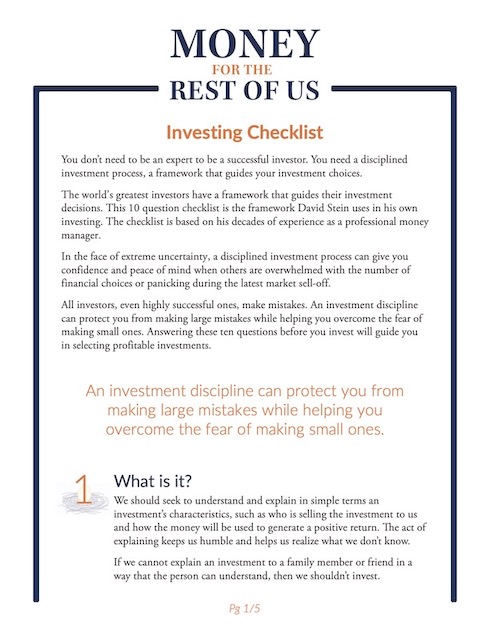
Become a Better Investor With Our Investing Checklist
Master successful investing with our Checklist and get expert weekly insights to help you build your wealth with confidence.
Related Episodes
540: Beyond Munis — New ETFs for Tax-Efficient Bond Investing
506: Should You Retire Early and Live Outside Your Home Country? With Joshua Sheats
425: How Profits Motivate Change
Transcript
Welcome to Money for the Rest of Us. This is a personal finance show on money, how it works, how to invest it, and how to live without worrying about it. I’m your host, David Stein. Today is episode 550. It’s titled, “Asset Location: Where You Invest, Where You Live, What You Can Access.”
A Taxable Client
Recently, LaPriel and I were in South Florida, and the first night we stayed in Coral Gables. And being there reminded me of a client that I used to have in Coral Gables. This was a medical malpractice insurer. I’d only been an institutional investment advisor a couple of years, and boy, was I in over my head.
This was a client that had a board that was made up of doctors, and they ran this small medical malpractice insurer. And most of my experience in working with clients at that point had been university endowments, foundations, clients that didn’t care about taxes, because they didn’t pay taxes; they were not for profits.
This was taxable, this insurance company, and they were very concerned about after-tax returns and after-tax income. And I found myself, because I was both an advisor but I also had to do some analysis, taking their performance and tax-adjusting it; taking the income and reducing it by the taxes, and any gains. And it was very manual, but the entire approach to investing was different because of this focus on what is the after-tax income.
Now, that’s not that much different than what we face as individual investors, but it often isn’t at the forefront as we talk about asset allocation, which is about dividing financial assets into different categories based on their expected return and risk, and then we decide “Well, how much do we allocate to stocks, versus bonds, versus real estate?”, and we’re trying to build a diversified portfolio.
Asset Location Defined
Asset location is different. It’s focused on deciding which type of account those assets should be placed in in order to maximize the after-tax return on the portfolio. And so we have taxable accounts, like a regular brokerage account, we have a tax-deferred account such as a 401k plan, an individual retirement account in the US, and then there are tax-free accounts such as Roth IRAs, where there’s no taxes on the income, on realized gains or withdrawals.
But with a tax-deferred account, there also isn’t taxes on the income and gains, but you’re taxed on any withdrawals from that IRA, or that tax-deferred account. And then the taxable account—all kinds of taxes, both on income and gains. So this medical malpractice insurer—they were taxable, and they were very focused on “How do we maximize our after tax income?”
Now I’ve been focused on asset location. I realized, while I’ve covered it in Plus episodes, I’ve never really done a regular podcast on it, and I wanted to sort of review all the literature again, to make sure that we’re being effective in teaching the principles of asset location.
Because one of the things that we’re working on, that we’ll potentially do, is a live portfolio building workshop in terms of helping individuals to actually implement portfolio rebalancing or creating a new portfolio, and helping individuals do this as a live cohort over three to four weeks. And so as part of that, that would involve some discussion on asset location.
Capital Reservoirs
But before I share those asset location principles, I wanted to zoom out a bit and consider where asset location fits in the broader context of our lives. I have shared a quote in the past by Henry David Thoreau, the philosopher. He was a walker, he would walk for hours every day, and he said, “No wealth can buy the requisite leisure, freedom, and independence which are the capital in this profession, the profession of walking.” Now, we usually think of capital as a financial asset.
But for Thoreau, he inverts it. Capital for the walking profession is leisure, freedom, and independence. And as I’ve been working on this next book, I’ve been writing recently about a capital reservoir that we have. This reservoir includes our freedom and independence, as Thoreau says, but also our skills, education, health, mobility, savings, time, our experiences, relationships, our life energy. You have this huge reservoir of capital.
And what capital does — these are assets that we have, both tangible and intangible, that expand our choices, give us more opportunity. This capital is all that we have been gifted and accumulated during our lifetimes. And as our capital grows, because capital expands our choices, with more capital, our capacity to live more abundantly expands.
And so that’s kind of the metaphor, this capital reservoir. But with something like that, there’s a temptation to optimize it. When we optimize something, we’re seeking the best solution that satisfies a given goal subject to constraints. If we’re trying to optimize asset location in a portfolio, we’re trying to maximize our after-tax returns, given the constraints of the various investment types that are there: the taxable, tax-deferred, and tax-free.
But when we think about our reservoir of capital that contains all of those things—skills, education, mobility, health—that’s not something that we can optimize, because it’s so expansive, and it can’t be flattened out into a mathematical formula, because there’s a lot of intangibles in there.
So what we’re trying to do with our capital reservoir is to calibrate it, to make sure that we’re understanding the trade-offs that we face every day. Should I expend some of my life energy to purchase this new television? Will doing so increase my abundance? Should I spend time taking a new course to learn something new? Is that worth my time?
As a Money For the Rest of Us Plus member, you are able to listen to the podcast in an ad-free format and have access to the written transcript for each week’s episode. For listeners with hearing or other impairments that would like access to transcripts please send an email to team@moneyfortherestofus.com Learn More About Plus Membership »
