I share five business practices that have carried me through internet bubbles, financial crises, business pivots, and now the rise of AI.

Show Notes
Gregor Macdonald – Cold Eye Earth
Libsyn Statistics, visualized—Livewire Labs
The Big Bang: A.I. Has Created a Code Overload By Mike Isaac and Erin Griffith—The New York Times
Episode Sponsors
Square – Get up to $200 in hardware
Delete Me – Use code David20 to get 20% off
Live Portfolio Cohort – May 2026
Become a Better Investor With Our Investing Checklist
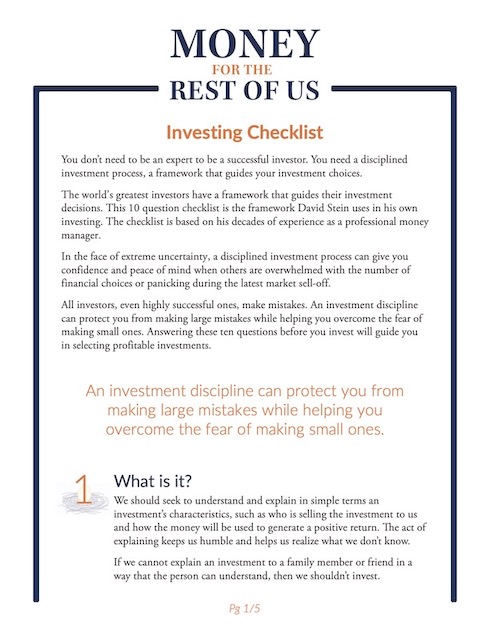
Become a Better Investor With Our Investing Checklist
Master successful investing with our Checklist and get expert weekly insights to help you build your wealth with confidence.
Related Episodes
496: Are You Taking Enough Aspirational Risk?
535: Six Principles for Thriving Under Uncertainty and How Big Tech Is Doing the Opposite
Transcript
Welcome to Money for the Rest of Us. This is a personal finance show on money, how it works, how to invest it, and how to live without worrying about it. I’m your host, David Stein. Today is episode 555. It’s titled “Five Practices That Have Shaped My Career.”
Taking Notes
Tomorrow I’m speaking to a graduate finance class at the University of Arizona. It’s something that I do about once a year. The professor invited me to share what I’ve learned across a 30-year career as an investment advisor, an author, an entrepreneur. And as I thought about it, I’ve narrowed it down to five practices.
The first I learned really my first day at university. In high school, the teachers would write all the notes on the board, and I would just copy them down. That first class, the professor just started speaking, and I. “What do I write down?” I even asked the girl sitting next to me, like— well, at least I watched what she was doing, that she was writing some of the stuff down, and so I started taking notes. That’s a practice that I continued, obviously, throughout my undergraduate, my graduate, but I have continued to do that throughout my professional life.
I started by writing down in hardcover Moleskine notebooks, and I would fill one up, I’d write the next one down. But problem with Moleskine is— yeah, you can kind of go back and review, but you can’t really search that. And so when technology came along, where you could record it online in somewhat of a wiki format, that’s what I did.
Starting with Social Texts, 2005, I used Backpack by Basecamp, formerly 37signals; that was in 2007. In 2008, I started using Evernote, and I used primarily Evernote and Basecamp for our business, as well as Backpack, up until 2019, when I started using Roam Research for most of my notes, with the exception of things that have to do strictly with organizing our business, and we continued to use Basecamp. I also have kept a written journal since the seventh grade. Now, I generally just write a summary post by hand, once a year.
So in thinking about this note-taking—I’ve not used Evernote in a long time, but I have all these notes, and I figured out today how to export them as HTML, and then I used Claude Cowork, that basically formatted the HTML into a Markdown file that I could import into Roam Research. So hey, there’s something AI could do—format an HTML file.
So then I was reviewing the notes—which is why it’s such a helpful practice; I occasionally go back—and I found a note from 2009 on Panarchy. I was in the process— I was reading a book by that topic, Lance Gunderson and C.S. Holling. I was writing our— it would have been our quarterly market commentary, strategy report at FEG Advisors, and I was introduced to this concept of panarchy, and how it describes how complex systems change over time. Everything’s connected, but you have different layers; you have microbes that live and die very quickly, you have trees that live longer.
I was recently visiting where I grew up in Cincinnati, and it felt familiar, my neighborhood—I drove by the house I used to live at—because some of the trees were still there. They’ve been there now 50 years or more; probably close to 100 years, because they were big even when I was small. So they change much more slowly. And so you have these higher-up levels in the panarchy that are persistently there.
As a Money For the Rest of Us Plus member, you are able to listen to the podcast in an ad-free format and have access to the written transcript for each week’s episode. For listeners with hearing or other impairments that would like access to transcripts please send an email to team@moneyfortherestofus.com Learn More About Plus Membership »
