SpaceX, Anthropic, and OpenAI are all going public. Why now? And what will their weight be in index funds? What other U.S. ETF options are there if you don’t want to have such a high concentration in stocks tied to AI. And finally, if you do buy SpaceX, what would need to happen to earn a reasonable return on your investment?
Show Notes
Elon Musk Is Dropping a Boulder in a Kiddie Pool by Matteo Wong—The Atlantic
Passive Investing and Market Quality by Philipp Höfler, Christian Schlag, and Maik Schmeling—SSRN
Investments Mentioned
iShares Core S&P 500 ETF (IVV)
Tema S&P 500 Historical Weight ETF Strategy (DSPY)
Defiance Large Cap ex-Mag 7 (XMAG)
Invesco S&P 500 Equal Weight (RSP)
Invesco FTSE RAFI US 1000 (PRF)
Episode Sponsors
Delete Me – Use code David20 to get 20% off
Become a Better Investor With Our Investing Checklist
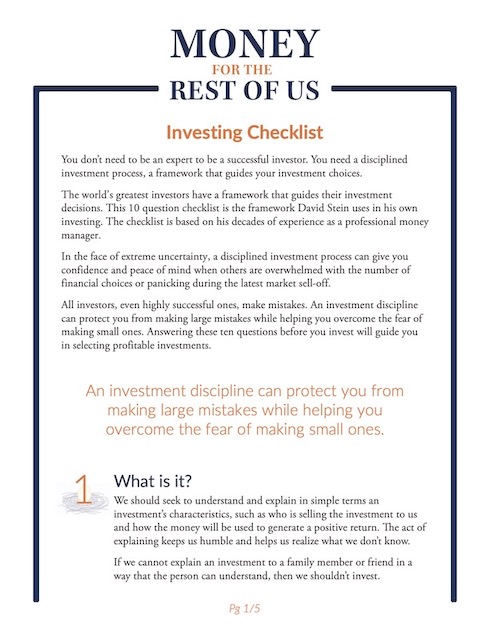
Become a Better Investor With Our Investing Checklist
Master successful investing with our Checklist and get expert weekly insights to help you build your wealth with confidence.
Related Episodes
460: Should You Be Invested 100% in Stocks Before and During Retirement? A Recent Study Says Yes.
458: Dissecting Stock Returns: Financial Engineering or Genuine Growth?
Transcript
Welcome to Money for the Rest of Us. This is a personal finance show on money, how it works, how to invest it, and how to live without worrying about it. I’m your host, David Stein. Today is episode 558. It’s titled “Will You Be Forced to Own SpaceX and Other AI Stocks?”
This week, SpaceX is reportedly going to go public. They have filed their S-1 statement. The estimate—it will be priced at about $135 a share. They’re seeking to raise about $80 billion, at a total market capitalization of about $1.8 trillion. That’s big.
If we think of the largest company that’s publicly traded in the U.S, it’s NVIDIA, and they have a market cap of about $5 trillion. The market capitalization is the price of a stock times the number of shares outstanding.
But we’ll see in this episode that in terms of its weight in an index fund that tracks the S&P 500 index, it depends on how much of the company’s actually shares are floating, in other words, able to be traded. In the case of SpaceX, it’s going to be pretty small because Elon Musk will maintain most of the control of the company, and they’re only raising $80 billion. But then again, the index providers can adjust their rules, and we’ll get to that.
Starlink
Now, I first became aware of SpaceX as their Starlink product. We’ve owned a cabin in Idaho about eight years. When we got there, there was a dish on the side of the wall, or on the side of the cabin, and it was pointing to a local provider of internet. And even though I had a dish, and I’m pointing to their towers, they said, “We’re not going to sell you internet.
We’re out of capacity.” And so for several years, our only internet when we went to our cabin over the summer was what we could get with our cell phone. Until we bought a Starlink dish. And I think this was probably 2019, 2020. So we still have that Gen 1 dish. It still works great. I’ve bought a second dish, a mobile dish, that I use when I record the podcast out in our studio. And I love the product. It just works. It’s amazing that we have these low-level satellite dishes, and we can get internet, and it’s just—it’s an incredible product.
SpaceX Total Addressable Market
Now, I took a look at the S-1 filing, and when we look at what is it that SpaceX does, what they’re promising, here’s their mission statement: “Our mission is to build the systems and technologies necessary to make life multi-planetary.” Now, that’s ambitious. They want to understand the true nature of the Universe, and extend the light of consciousness to the stars. I don’t know what that last part means, but again, it’s ambitious. And when they look at the level of the opportunity that they describe, they mention that space represents the largest economic frontier in human history.
And there’s really three avenues that they’re focused on. There’s the connectivity aspect of it, which is Starlink, the ability to have internet, there’s obviously the ability to send rockets into space, and they have a huge market share there. But when we look at what they call the total addressable market—and they think it’s the largest in human history, and there are a lot of promises in this S-1 about how massive this opportunity is. And they need to describe how massive it is, given the valuation they’re putting on Starlink.
The biggest opportunity—so they say $28.5 trillion is their total addressable market. That’s really the size of the pond that they’re fishing in, and it’s massive. But if you see how they break it down. They have the connectivity, with Starlink, about $880 billion of the $28.5 trillion that they’ve identified.
They believe that space-enabled solutions is about $1.6 trillion, and that would be rockets, and things like that. There’s enterprise and government opportunities. But the biggest is AI. Part of it, consumers, about $600 billion. But $23 trillion of their $28.5 trillion total addressable market is what they call enterprise applications as it relates to AI. We’re just in the early stages of that.
But if you think about—so here’s a company going public for the first time, they file their S-1, they have Grok, they have an AI model. But of all the opportunities, the biggest, they think, is AI. And part of that is sending AI—building data centers in space, and they outlined it in the S-1. And that’s kind of—it’s a huge aspect of what they’re doing.
As a Money For the Rest of Us Plus member, you are able to listen to the podcast in an ad-free format and have access to the written transcript for each week’s episode. For listeners with hearing or other impairments that would like access to transcripts please send an email to team@moneyfortherestofus.com Learn More About Plus Membership »
