David shares nine lessons a listener followed to become a millionaire.

Topics covered include:
- The benefit of underspending on housing
- What rate of return and how much would you need to save to grow a portfolio to one million dollars
- Why historical studies of the S&P 500 returns are misleading
- David’s recent portfolio mistake
Show Notes
There are no show notes for this episode.
Episode Sponsors
Delete Me – Use code David20 to get 20% off
Become a Better Investor With Our Investing Checklist
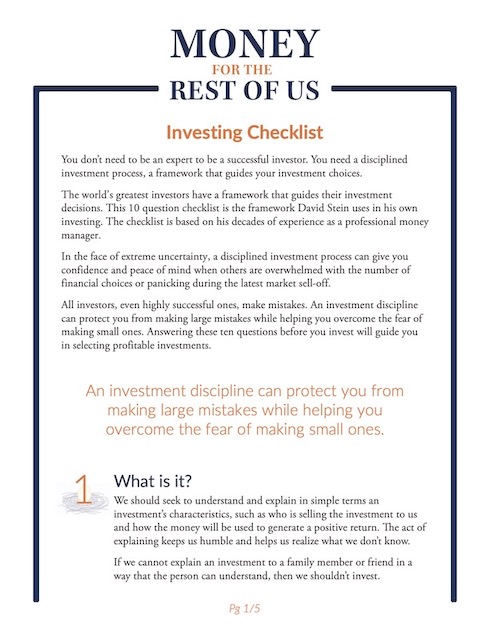
Become a Better Investor With Our Investing Checklist
Master successful investing with our Checklist and get expert weekly insights to help you build your wealth with confidence.
Related Episodes
498: What I Learned Investing in the Past Decade
454: How To Invest – Ten Rules of Thumb for Individual Investors
Transcript
Welcome to Money for the Rest of Us. This is a personal finance show on money, how it works, how to invest it, and how to live without worrying about it. I’m your host, David Stein.
Today is episode 559. It’s titled “A Listener’s Path from Zero to a Millionaire.” This week on the show, we have a remarkable story from a long-time listener of Money for the Rest of Us. He is a lifetime member of our premium community, Money for the Rest of Us Plus, and 10 years ago, he was in debt and they were struggling. They couldn’t even imagine being able to retire.
Their retirement plan was to hopefully save $30,000 to be able to then buy a tiny house, and they still had their condo, and they could get rent from their condo, and that would allow them to live in retirement. That was 10 years ago. Now they’re a millionaire, and this listener gave me permission to use anything from his email that he shared with me. He doesn’t want me to share his name or his spouse’s name, and that’s perfectly fine, but it’s a fascinating story that I wanted to share with you today.
Lesson One: Keep Learning
There’s nine lessons we can learn from this listener. How did he get there? What was the mindset? What were the strategies they used? A lot of what this couple implemented were things that we’ve discussed numerous times on the podcast. He said he discovered the podcast in 2015, and about that time I’d done about 60 episodes. This individual recently had turned 40; he’d been a personal trainer for 15 years.
At that point, he said he’d spent a lot of time training with high-net-worth individuals, and they tended to have their opinions and shared them. But what this member or listener found is that he needed to get out of what he calls his echo chamber. He needed other sources of information, and that’s when he discovered the Money for the Rest of Us podcast. That’s really the first lesson that we can see: keep learning. Exit the echo chamber and seek a diversity of voices. That’s something I’ve shared numerous times on the podcast.
I’ve mentioned the number of periodicals that I read, and part of this learning is figuring out, “Well, what is your learning style?” Presumably, this listener learns better by listening. I don’t. If somebody shares a podcast with me, I’ll go find the transcript and read it, because I can read it and process the information better. I just don’t learn as well listening or hearing people. I want to see words.
He went out, and he was just getting kind of one view of the world from his clients, and he felt like he needed to get other opinions. He discovered my podcast; presumably he’d listened to other podcasts, but he listened to every single episode of our show, every premium podcast of our show. He said he watched the lessons, the video lessons, anything he could find, and slowly it began to transform his view of money. Because he and his spouse did not have money growing up.
They did not come from a wealthy background, similar to us. I grew up poor. We were on welfare. We lived because people donated food to us. But in my case, my mindset also changed. When I was 10 or 11 or 12, my mother was in real estate, struggling, but I started reading books: books by Dale Carnegie, books by Napoleon Hill, by Zig Ziglar, by Norman Vincent Peale. All of these authors—you know, many of them were writing in the ’50s, ’60s, ’30s, ’70s—I mean, Zig Ziglar, a little more contemporary.
But they changed my mindset on money and on being an entrepreneur, and realized I didn’t have to be poor, like we were. Now, I didn’t really know what it was like to be rich, but slowly, my mindset started to change. I started launching little micro businesses, many of which—well, all failed, except for a newspaper route, or some landscaping, cutting lawns. But this individual, his life circumstances started to change.
As a Money For the Rest of Us Plus member, you are able to listen to the podcast in an ad-free format and have access to the written transcript for each week’s episode. For listeners with hearing or other impairments that would like access to transcripts please send an email to team@moneyfortherestofus.com Learn More About Plus Membership »
