How the Iran conflict and other developments could lead to another major financial crisis. What is different today from 2008? Why trying to seed a revolution is so risky. And finally, what can we do to prepare ourselves for the next financial crisis?
Show Notes
Read Trump’s full statement on Iran attacks—PBS News
The Poverty of Historicism By Karl Popper
Iran Is Trying to Defeat America in the Living Room By Karim Sadjadpour—The Atlantic
‘Once and for All’ Means Never By Thomas L. Friedman—The New York Times
AI Isn’t Coming for Everyone’s Job By Adam Ozimek—The Atlantic
Episode Sponsors
Masterworks – Get priority access to invest in shares of multimillion-dollar art offerings.
DeleteMe makes it quick, easy, and safe to remove your personal data online. Use code David20 to get 20% off
Become a Better Investor With Our Investing Checklist
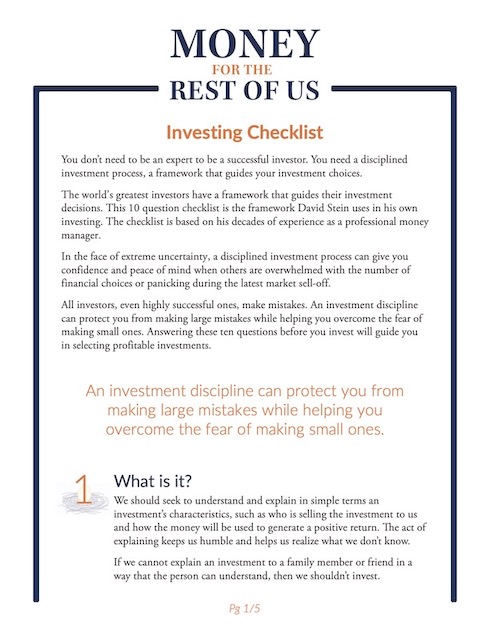
Become a Better Investor With Our Investing Checklist
Master successful investing with our Checklist and get expert weekly insights to help you build your wealth with confidence.
Related Episodes
291: How To Survive the Coronavirus (COVID-19) Shutdown
377: What If It’s Different This Time?
Transcript
Welcome to Money for the Rest of Us. This is a personal finance show on money, how it works, how to invest it, and how to live without worrying about it. I’m your host, David Stein. Today is episode 553. It’s titled “Is Another Great Financial Crisis Coming? Five Ways to Prepare.”
After I released episode 552 of the podcast two weeks ago, I got an email from Chris, a listener, who said, “I’m shocked. No words on the economy today.” Now, that was released on March 11th, two weeks after— or not even two weeks after the US and Israel attacked Iran. I had just spent the prior week composing our monthly strategy report for Plus members and Asset Camp.
I had dug deep into potential consequences of what was going on with Iran, and I just— I wanted it to go away. And I was hoping it would go away. But now, it’s been almost four weeks. Oil prices remain over $90 per barrel, up 40%, and there are potential longer-term consequences of what is happening there. So we’re going to talk about it, but more importantly, we’re going to talk about what can we do if indeed another great financial crisis is coming.
Iran Conflict
So just to catch you up, on February 28th, 2026, President Trump made an announcement. He said, “A short time ago, the United States military began major combat operations in Iran.
Our objective is to defend the American people by eliminating imminent threats from the Iranian regime.” Later in that statement, he said, “That’s very simple. Iran will never have a nuclear weapon. That’s the objective.” He said they tried to repeatedly make a deal, and at times Iran wanted to, at other times they didn’t, they went back and forth. He said they rejected every opportunity to renounce their nuclear ambitions, and Trump said, “We can’t take it anymore.”
And so the U.S. military is undertaking, in his words, a massive and ongoing operation to prevent this very wicked, radical dictatorship from threatening America and our core national security interest. He also reached out to members of the Islamic Revolutionary Guard, the armed forces, and all the police, and says, “Lay down your weapons and you’ll have complete immunity, or the alternative is you’ll face certain death. So, lay down your arms”, Trump said, “and you’ll be treated fairly with total immunity.”
Finally, he said, “To the great proud people of Iran, I say tonight that the hour of your freedom is at hand. Stay sheltered. Don’t leave your homes. It’s dangerous outside. But when we are finished, take over your government. It’ll be yours to take. This will be probably your only chance for generations.”
So then, the next week I spent time, as I mentioned, writing the report, and I said, “Despite the initial sell-offs in stocks following the start of the Iran conflict, historical evidence shows that wars are not necessarily bad for stock markets.” In many cases, the uncertainty about whether the war will happen has proven worse for markets than the war itself.
“But”, I wrote, “the key exception is when global supply chains are significantly disrupted, or when commodity prices remain extremely elevated for an extended period. In this case, the duration and severity of any disruption to oil shipments through the Strait of Hormuz is the key variable. That will determine whether this conflict follows the more typical pattern of a short-term sell-off and recovery, or evolves into something more damaging for the global economy.”
As a Money For the Rest of Us Plus member, you are able to listen to the podcast in an ad-free format and have access to the written transcript for each week’s episode. For listeners with hearing or other impairments that would like access to transcripts please send an email to team@moneyfortherestofus.com Learn More About Plus Membership »
