A new executive order could radically reshape retirement investing by allowing private equity, crypto, and gold in 401(k) plans. This episode examines the factors driving the demand for alternative assets in defined-contribution plans, the potential risks to everyday investors, and why fiduciary rules and financial literacy gaps still matter.

Show Notes
U.S. Labor Department Allows Private Equity in 401(k) Plans by Chris Cumming—The Wall Street Journal
State Street New TDF Includes Private Assets by PSCA Net Staff—PSCA
The Power of Private Markets by Robert Crothers et al.—BlackRock
UNITED STATES COURT OF APPEALS FOR THE NINTH CIRCUIT OPINION No. 22-16268
The Relentless Ask: Private Markets Are Eating the World by Michael Batnick—The Irrelevant Investor
Don’t Buy Into This Easy Fix for Stock-Market Craziness by Jason Zweig—The Wall Street Journal
On Endowments and Unintended Consequences by Paul Kedrosky—Paul Kedrosky
Episode Sponsors
Become a Better Investor With Our Investing Checklist
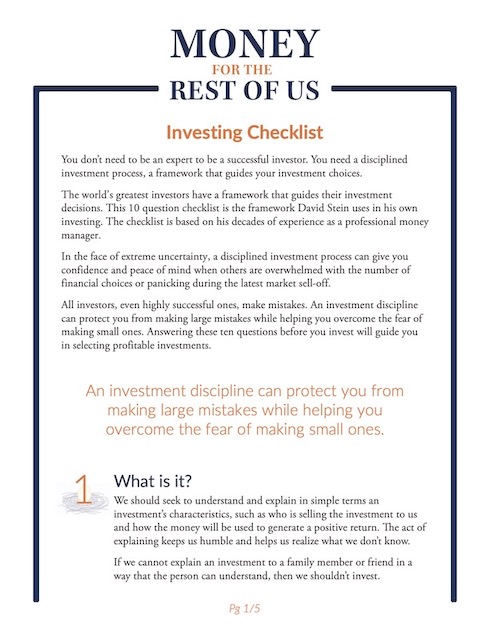
Become a Better Investor With Our Investing Checklist
Master successful investing with our Checklist and get expert weekly insights to help you build your wealth with confidence.
Related Episodes
509: How to Invest in Private Credit / Direct Lending?
497: How to Fix the Retirement Savings Crisis
490: Should You Invest in Private Equity?
Transcript
Welcome to Money for the Rest of Us. This is a personal finance show on money, how it works, how to invest it, and how to live without worrying about it. I’m your host, David Stein.
Today is episode 532. It’s titled, “Should Private Assets, Gold, and Crypto be Investment Options in 401k and Other Defined Contribution Plans?”
A Potential Executive Order to Allow More 401k Options
Last week, both the Wall Street Journal and Financial Times reported that President Trump is expected to sign an executive order in the coming days that would allow more private market investments in defined contribution plans in the U.S.
The executive order is expected to direct the Labor Department and the Securities and Exchange Commission to provide guidance to employers and plan administrators as to how these type of private assets could be included. This could include private credit, private equity, leveraged buyout funds, venture capital, it could include gold, cryptocurrency. We’re not exactly sure.
The White House, in a statement released to the Financial Times, said President Trump is committed to restoring prosperity for everyday Americans and safeguarding their economic future. No decisions should be deemed official, however, unless they come from President Trump himself. Wall Street Journal and Financial Times are talking to people in the administration that are indicating this executive order is coming.
Now, the dollars at stake are huge. There’s $12.4 trillion in assets in U.S. defined contribution plans, including over $9 trillion in 401k plans. What’s interesting is right now, there actually isn’t any federal law that prohibits companies from including private equity in their 401k plans, but companies are worried about getting sued. In fact, Intel in 2015 was sued by one of its employees because Intel included private equity and hedge funds in their defined contribution plan. That was in 2015.
Just this year, an appeal ruled against those employees that sued, saying that Intel didn’t breach ERISA, which is the Employment Retirement and Income Security Act. That’s the laws that 401k plans define, benefit pension plans operate under.
And they have a fiduciary standard to act in the best interest of plan participants. And the court ruled that in this case, Intel acted as faithful fiduciaries, and that the plaintiffs didn’t prove that employees have been harmed by including these additional investment options. Yet, employers are still worried about being sued.
Existing Regulations for Private Capital in 401k Plans
In 2020, the Department of Labor issued additional guidance to plan sponsors that allows target date funds, which is in many cases the default option within 401k plans. A target date fund would be like a 2050 funds, for those planning on retiring in 2050. They can include private equity as one of the assets in these target date funds. And to me, that makes sense.
These are diversified portfolios, they have a number of different assets in them. And to the extent that defined benefit pension plans have about 13% in private capital, it would make sense for a professionally managed target date fund to include additional diversification by allowing private equity and even private credit within those target date funds.
That’s very different than including a specific fund option that invests in gold within a 401k plan, or Bitcoin, or a venture capital fund within a 401k plan. That I don’t think is a good idea, and I’ll explain why in this episode.
Why Private Capital in Target Date Funds Makes Sense
This year, State Street Global Advisors launched a new target date fund. It’s called the State Street Target Retirement Index Plus Strategy. It includes traditional target date strategies, stocks, and bonds, but also includes some private investments managed by Apollo. BlackRock also seems to be poised to provide target date funds in this area also.
One reason it makes sense to include private capital only within a target date fund structure is because of how illiquid private capital can be. My former advisory firm, FEG, we launched some private capital fund of funds. Our first one we launched in 2011. They’ve now launched seven funds. I’m invested in six of those.
But if we consider those first two funds, the one launched in 2011, the other in 2014, it’s been 11 to 13 years later. And I look at my commitment—I’ve gotten out what I’ve put in, and the money I sent in in terms of capital calls, I’ve gotten that out.
But if you look at the value remaining in the second fund, that value is still worth basically what I put in; a remaining value locked in the fund. And about half of what I put in the first fund still remains locked in the fund. And it will probably be several more years. So this is a 15-year type investment in private capital, and that’s why there’s something called the illiquidity premium.
Ideally, one can earn a higher return in these private assets than they would in the public market because of the illiquidity. But I think this belongs within a target date fund, not allowing a private capital option within a 401k as a standalone fund option.
As a Money For the Rest of Us Plus member, you are able to listen to the podcast in an ad-free format and have access to the written transcript for each week’s episode. For listeners with hearing or other impairments that would like access to transcripts please send an email to team@moneyfortherestofus.com Learn More About Plus Membership »
