What’s the difference between hoarding and investing? There’s a reason markets built on productive assets—like stocks and bonds—are far larger than hoarding markets such as gold and cryptocurrency. In this episode, David explores why that is, and shares why he recently bought Zcash, and how it’s both similar to and different from Bitcoin.
Show Notes
The Largest Companies by Market Cap in October 2025—The Motley Fool (Accessed October 2025)
Selling Gold in the Diamond District – Money for the Rest of Us Substack
Episode Sponsor
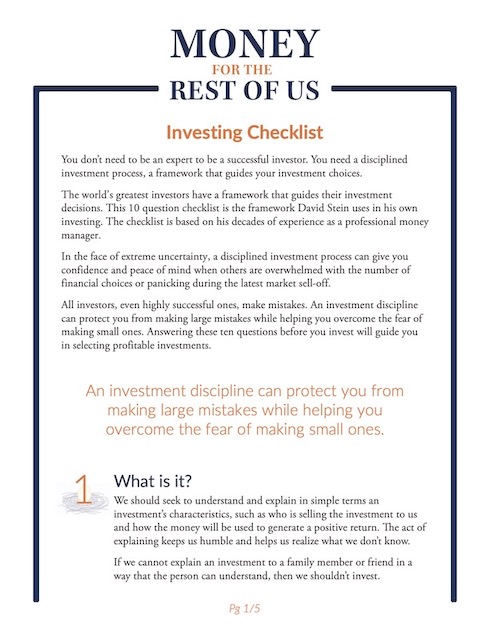
Become a Better Investor With Our Investing Checklist
Become a Better Investor With Our Investing Checklist
Master successful investing with our Checklist and get expert weekly insights to help you build your wealth with confidence.
Related Episodes
513: Crypto—Innovation or Insanity? Meme Coins, Hacks, and Strategic Bitcoin Reserves
432: Are the Economy and Financial Markets Zero-Sum Games?
496: Are You Taking Enough Aspirational Risk?
Transcript
Welcome to Money for the Rest of Us. This is a personal finance show on money, how it works, how to invest it, and how to live without worrying about it. I’m your host, David Stein. Today is episode 543. It’s titled “Hoarding FOMO and Zcash, a Private Bitcoin.”
Last month I received a text from a friend of mine who we have known each other for over a decade, and he is a smart investor, is very knowledgeable on cryptocurrency. And his text said, “You ever look into Zcash? It’s effectively private Bitcoin.” He said that he’s seeing non-hype-oriented crypto people that he respects talking about it more these days, and suggested that this
Now, I had looked into Zcash. In fact, I used to own it. I purchased four or five Zcash coins, that go by ZEC, in the summer of 2018. Paid around $150 or so per coin. This was when Circle, the issuer of the stablecoin USDC, sponsored our podcast. At the time, they were a relatively new company, they hadn’t launched a stablecoin yet. Their main offering was a crypto wallet that you could custody Bitcoin and other cryptocurrency. And I already owned Bitcoin and Ethereum by then. And so I bought Zcash for that crypto wallet, just to try out the wallet and make sure it worked.
Well, after Circle launched its stablecoin, it closed its crypto wallet and transferred the assets to Voyager. Voyager, you may recall, filed for bankruptcy in 2022, and at that point, my little Zcash holding was locked up. I was able to access a portion of the funds in 2023, and by then, Zcash was selling for $30 a coin.
Now, I didn’t think anything of it, because I own a dozen or so crypto coins and tokens, small positions, some of which have done well, and others have done terrible. These are speculations. I only put enough in that I’m willing to lose it all. And for some—Wrapped Luna, the Mirror Protocol—I effectively lost it all. Others, like Solana and Aave, have done better.
Crypto Market Size Relative to Equities
The total market capitalization of the crypto universe is about $3.8 trillion. That includes Bitcoin, Ethereum, and 18,000 other coins and tokens. For comparison, NVIDIA’s market cap is greater. One company, $4.7 trillion. Microsoft and Apple are each larger, at a $4 trillion market capitalization, than the entire crypto sphere. The U.S. stock market—let’s take the Wilshire 5000, an index that essentially comprises all the U.S. stocks, publicly-traded stocks.
Only around 3,400 stocks in that index now, hitting on the theme where there are just fewer companies publicly-traded, way more private companies. But the market capitalization is $68 trillion, compared to $3.8 trillion for the crypto universe. Now, market capitalization is the number of shares or the number of coins outstanding times the price. Gold, 216,000 tons in circulation—market capitalization using $4,000 an ounce of $28 trillion.
Now, of that $3.8 trillion capitalization for the crypto universe, 58% is Bitcoin, and the second largest is Ether at around 13%, followed by the very stablecoins around 8%. So there are thousands and thousands, close to 18,000 coins that make up 20% of the crypto universe.
Hoarding
When we buy Bitcoin or Zcash—and I’ll explain more about what Zcash does in this episode—when we own gold, this is hoarding. Hoarding means to hide something away for future use. We can hoard food. We can hoard ammunition. Some people hoard land; land that’s not farmed, they just own it. Hoarding is good, if not taken to an extreme. It provides a layer of protection against the unknown, including rising prices due to inflation.
And the logic of owning gold or Bitcoin or Zcash is that the supply of those assets grows slower than the supply of fiat currency. The U.S. money supply includes currency, checking, and savings accounts. Retail money market mutual funds has grown around 6% per year. Gold, around 3% a year. Bitcoin and Zcash they’re capped at 21 million coins, and the algorithm produces the coins, but the pace of increase is slowing, because every so often there’s a halving event. The reward that is received for miners that are securing the network, validating transactions, that reward is less and less over time, as Bitcoin and Zcash get closer to that 21 million coin cap.
And so when we hoard things, we want to hoard things that are scarce. But hoarding is different than investing. Investing differs from speculation. Speculation means there’s a disagreement on whether the price of an asset will increase or not. Many cases are difficult to value, because there isn’t any cashflow. Investing is when we are confident there will be a positive return. There’s a basis for it.
And usually, that’s because there’s some cashflow. For the stock market, it’s dividends, or the potential for dividends. Those dividends are growing because the earnings of the underlying companies are growing. They’re making things. They’re getting more efficient at making things or providing services. They’re innovating over time. They’re contributing to the growing economy, because economic growth, GDP, is a measure of the value, the monetary value of what is produced. And the stock market is made up of companies that are producing things, growing their cashflow, growing their earnings, growing the economic pie.
Gold, Bitcoin, and Zcash are not growing the economic pie. They’re just there to be hoarded, to provide a layer of protection. Now, Bitcoin and Zcash have other uses. They’re networks—secure networks that you can transfer Bitcoin or Zcash to someone else. And that’s the beauty of Bitcoin and Zcash, to transfer something of value, because people value it as digital currency somewhere else in the world. And as a store of wealth, digital gold, if people continue to trust it and trust the network. But it’s very different than owning stocks.
As a Money For the Rest of Us Plus member, you are able to listen to the podcast in an ad-free format and have access to the written transcript for each week’s episode. For listeners with hearing or other impairments that would like access to transcripts please send an email to team@moneyfortherestofus.com Learn More About Plus Membership »
