Why portfolio construction is messy, personal, and never perfect. We compare the pros and cons of several portfolio strategies, including target-date funds, risk parity, and role-based portfolios. We conclude with three AI-related fallacies that will help us better navigate the current moment.

Show Notes
Why Everything Suddenly Is ‘Perfect’ by Paula Marantz Cohen—The Wall Street Journal
Your Perfect Portfolio by Cullen Roche—Pan MacMillan
My Core Investment Values by Peter Lazaroff—Peter Lazaroff
Show Us Your Portfolio: Jared Dillian—Excess Returns: An Investing Podcast
The dystopian fantasy of uselessness by Stephen Cane—The Financial Times
Investments Mentioned
State Street Bridgewater All Weather ETF (ALLW)
RPAR Risk Parity ETF (RPAR)
AQR Multi-Asset Fund (AQRIX)
Episode Sponsors
Square – Get up to $200 in hardware
Delete Me – Use code David20 to get 20% off
Live Portfolio Cohort – May 2026
Become a Better Investor With Our Investing Checklist
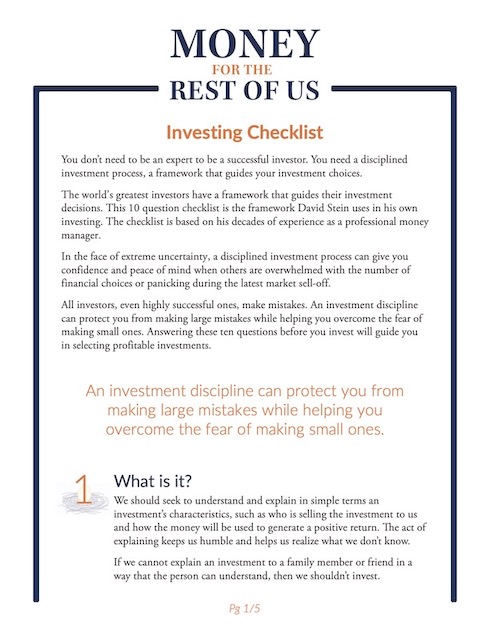
Become a Better Investor With Our Investing Checklist
Master successful investing with our Checklist and get expert weekly insights to help you build your wealth with confidence.
Related Episodes
491: The Five Layers of Investing
306: Three Approaches to Asset Allocation
Transcript
Welcome to Money for the Rest of Us. This is a personal finance show on money, how it works, how to invest it, and how to live without worrying about it. I’m your host, David Stein. Today is episode 554. It’s titled “There Is No Perfect Portfolio. Just Good Enough.”
Everything Is Perfect
Have you noticed over the past few years, as you have interacted with personnel in the hospitality space, whether you’re at a restaurant, maybe you’re at a hotel, and you do something, you order, and they say, “Perfect.” Everything is perfect. And I’m not the only one that noticed it. I actually looked to see if there’d been some academic study about that, because I don’t remember hearing “Perfect” as much a decade ago. What’s interesting though, is “perfect”, the word, it comes from the Latin “perfectus”, which means “to finish” or “bring to completion”.
And that use of perfect is what we see in grammar. In English you have present perfect tense, past perfect, future perfect. Originally, the word “perfect” meant “completed, not flawless”. But if we look at an essay I found by Paula Marantz Cohen in the Wall Street Journal, back in 2022—she’s a professor of English at Drexel University in Philadelphia.
The title of her piece was “Why Everything Is Perfect.” And she used a phrase, she called it “macro praise”, where the speaker is just overdoing praise to people, including saying, “Hey, perfect.” The example she gives, “Thank you, Stephen, for your excellent question about whether we should be putting our trash cans closer to the curb. I think you are a hundred percent right in raising this point.” She thinks that maybe this idea to over-exaggerate praise and use terms like “perfect” is some individuals, younger generations perhaps—that’s what she’s saying—they have felt continually judged. And so there’s either you’re wrong, or it’s perfect; no ambiguity in between.
Now, she had a suggestion to saying “Perfect” all the time—say “Good enough.” So if you order at a restaurant, the server will say, “Good enough.” I don’t know if that’s going to work or not. We had brunch the other day with a friend.
Our server was Claire. She didn’t say “Perfect”, but she was an actor by training, very skilled, and she could have been—in fact, I suggested that she try stand-up. She was that good. Her friend asked her her name, and she said “My name is Claire.” And he said, “Oh, that’s a great name.” And she said, “Thank you. I got it for my birthday.” And the way she delivered that line was perfect. But she didn’t want to do stand-up because it requires failing, and failing again. And she’s learning to get comfortable with failing. Because when you fail, you’re no longer perfect. And that’s just the way it is.
Harriman House Books
Now, I mention it because I got an email from a publicist at Harriman House, and they’re publishing a whole suite of personal finance and investment-related books. One of them is by an acquaintance of mine, Peter Lazaroff, The Perfect Portfolio. It comes out in the fall. Another acquaintance of mine, Cullen Roche, wrote a book published by Harriman House earlier this year, or late last year, called Your Perfect Portfolio.
Also this fall is a book by Jared Dillian titled The Awesome Portfolio. If you look at some of the other lists—and they sent me kind of a photo of all these books lined up, and there is actually a sameness to it when you look at the covers. Very similar genre. Another one is The Retirement Answer, The Everything Code. And the idea—at least by the title, when you read some of the marketing—is there is a perfect answer. There is a recipe you can follow in your investing to build the perfect portfolio.
But when you actually dig into the text—and I did. I bought Cullen’s book and read it this weekend. Lazaroff’s book’s not out yet. I requested the PDF. That’s not available. But I have a sense of what’s in there. And they’re both kind of along the lines of how they define a perfect portfolio.
The perfect portfolio for you is not necessarily the perfect portfolio for somebody else. It’s the portfolio you can stick with. And Roche gives the example of research on dieting. Many, many diets work. But what they’ve found is the diets that work best are the ones that the individuals actually stick to. And portfolio management, Roche points out, is no different.
He writes, “You don’t need to find the perfect portfolio for all people at all times. You need to find the portfolio that’s perfect for you. And then you need to remain loyal to it long enough for it to work for you.” Lazaroff writes, “If there’s a perfect portfolio, it’s the one you can stick with through thick and thin.” So these are behavioral elements when it comes to the perfect portfolio. And even the portfolio itself, if you can stick to it, it doesn’t mean it’s perfect. It might be complete for you at that stage of your life, but it can change.
As a Money For the Rest of Us Plus member, you are able to listen to the podcast in an ad-free format and have access to the written transcript for each week’s episode. For listeners with hearing or other impairments that would like access to transcripts please send an email to team@moneyfortherestofus.com Learn More About Plus Membership »
