We explore the forces likely to shape financial markets in 2026 and how to make better decisions as you pursue your goals this year.
Topics covered include:
- The difference between intentions and resolutions
- Key behavioral biases and how to overcome them
- The cautionary tale of a private real estate fund that went public
- Is the affordability crisis real?
- The big test for AI in 2026
- The financial and economic outlook for the year
Show Notes
A Slightly Better You in the New Year by Roland Fryer—The Wall Street Journal
Handbook of Cognitive Biases—Federal Intelligence Service FIS
America’s affordability crisis is (mostly) a mirage—The Economist
When Your Private Fund Turns $1 Into 60 Cents by Jason Zweig—The Wall Street Journal
Canadians Are Furious After Real Estate Funds Lock Up Their Money by Paula Sambo—Bloomberg
Blue Rock TI+ Annual Report—Securities and Exchange Commission
Is AI More Like a Mind or a Market? by Walter Frick—Bloomberg
Don’t Fear the Bubble Bursting by Carl Benedikt Frey—The New York Times
Episode Sponsors
Masterworks – Invest in multimillion-dollar artwork offerings
Delete Me – Use code David20 to get 20% off
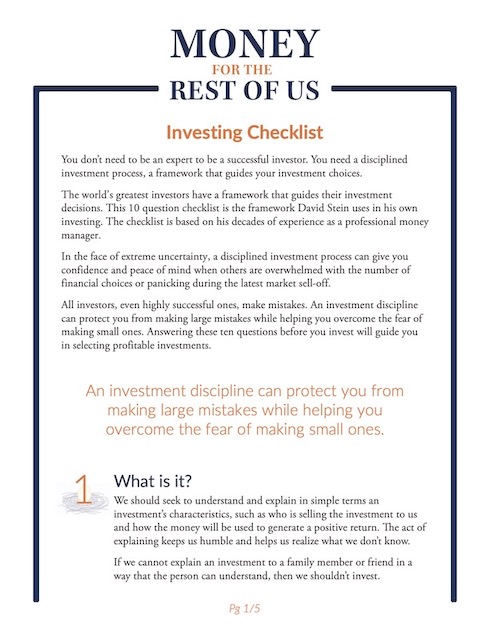
Become a Better Investor With Our Investing Checklist
Become a Better Investor With Our Investing Checklist
Master successful investing with our Checklist and get expert weekly insights to help you build your wealth with confidence.
Related Episodes
484: 7 Steps to Living a Longer Life
414: Use Caution with Private REITs like Blackstone’s BREIT
Transcript
Welcome to Money for the Rest of Us. This is a personal finance show on money, how it works, how to invest it, and how to live without worrying about it. I’m your host, David Stein. Today is episode 548. It’s titled “What I Did Over the Break, and What to Expect in 2026.”
Year-end Break
For the past 25 years or so, I’ve basically not worked during the last few weeks of the year. I did it as a new institutional investment advisor, as I was able to accrue more vacation, I certainly have done it with Money for the Rest of Us, as we’ve not published episodes, typically, over the holidays. Last year, our family and I were in Costa Rica, over the year-end break, this year, we were in Tucson. What I wanted to do in this episode is to kind of share what I did during the break. What did I learn? What are my routines at year-end in terms of preparing for the upcoming year?
I generally don’t have a schedule when it comes to what I do at year-end. There’s certain things that I have done over the years that helped me plan, helped me reflect on what happened in the prior year. There’s a saying from French philosopher Gustave Thibault, “Measure repeats, rhythm renews.” Natural cycles always allow for the unforeseeable. I like that idea of rhythm. I have year-end rhythms that I follow, but I’m flexible. I allow room for the unforeseeable. And there’s certainly things that came up, and that flexibility allows us to address those things.
A big part of what I do at year end—it tends to be a lot more physical activity, sort of those year-end things that just need to get done. When we’ve lived in Tucson, we live on about an acre, and it’s desert fauna, so we have a lot of trees that need trimming: the palo verde, the mesquite, the acacia trees. And so usually, over the break, I’ll order a dumpster, and then I’ll go out and trim trees and fill the dumpster.
Took lots of hikes over the break, played some tennis, I spent time with friends. We had a friend, one of my former associates at FEG, he stayed with us for a few days. We went out to dinner with some friends at a Oaxacan restaurant, and I had chapulines for the first time, which is a roasted season grasshopper that Oaxacans put on various meals, and tasty.
But one of the big things that I do is decide my intentions for the next year. And these are not goals, they’re not resolutions.
Awful Forecasters of Our Future Behavior
Over the break, I saw an article by Roland Fryer—he’s an economics professor at Harvard—and the piece was in the Wall Street Journal. He wrote, “We are awful forecasters of our own future behavior.” He referenced a study that was done back in 2006, where some scholars had data of 7,000 individuals, and it related to their gym memberships, whether it was a pay-as-you-go, monthly, or an annual membership.
And what they found is that those that paid monthly ended up paying more than they would if they just did pay-as-you-go. They paid a higher rate because it was monthly, but they didn’t go as much, so they could have saved, on average, $10 to $17 per visit had they just paid every time they went.
They also found that people that signed up monthly, where you have the option to quit at any time, tended to stay longer than people that just signed up for an annual plan. Which is interesting when it comes to gym membership, because we find with members of Money for the Rest of Us Plus that those that sign up for monthly tend to stay shorter amounts of time than those that sign up for an annual plan.
But for this study, that was not the case. And what they considered was explanations was overconfidence about future self-control. The idea that when we make a resolution, such as to go to the gym, and “I’m going to get up every single morning, and I’m going to go work out at the gym, or five days a week”, we’re forecasting our future willpower.
Fryer says we picture an idealized version of ourselves: disciplined, virtuous, rising at dawn. He describes it as our current present self making a contract with our future self that just considers it a suggestion, because we have what’s known as present bias. The alarm rings at 5.30 or 6 a.m., and our person at that time, the cost of getting up, the drowsiness—it overwhelms that resolution made weeks earlier.
As a Money For the Rest of Us Plus member, you are able to listen to the podcast in an ad-free format and have access to the written transcript for each week’s episode. For listeners with hearing or other impairments that would like access to transcripts please send an email to team@moneyfortherestofus.com Learn More About Plus Membership »
