Why we have to navigate investing, business, and life with a compass rather than a GPS. David also provides an update on what he has learned from hosting live portfolio cohorts and letting AI analyze his portfolio trades over the past 12 years.
Show Notes
Almost Reckless by Amy Smilovic—Penguin Random House
Episode Sponsors
Square – Get up to $200 in hardware
Delete Me – Use code David20 to get 20% off
Become a Better Investor With Our Investing Checklist
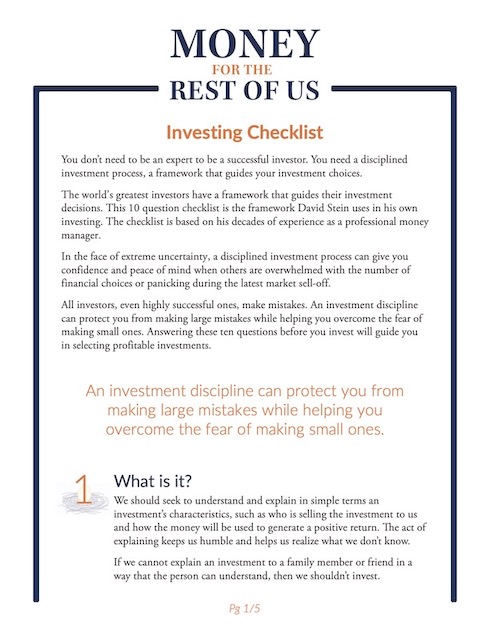
Become a Better Investor With Our Investing Checklist
Master successful investing with our Checklist and get expert weekly insights to help you build your wealth with confidence.
Related Episodes
555: Five Practices That Have Shaped My Career
Transcript
Welcome to Money for the Rest of Us. This is a personal finance show on money, how it works, how to invest it, and how to live without worrying about it. I’m your host, David Stein. Today is episode 556. It’s titled “We Are All Wayfinders.”
Live Portfolio Cohort Update
This morning, I hosted our third session of our live portfolio cohort. This was a new offering from Money for the Rest of Us, where we worked with a small group of investors in a live setting, as they work through some of their portfolio construction challenges. It’s not a course, nor is it specific investment advice.
The best descriptor I can think of is, it’s a workshop like they have in fiction, novelists. Way back two decades ago, I was working on a novel, and I attended a weekend workshop in Aspen, where we worked with a novelist. It was a group of us, and we talked about our novels, our short stories, and it was collaborative. That’s kind of what this is.
We did a launch, we had hundreds of people on our webinar, we had a lengthy wait list. We were targeting individual investors with 5 to 10 years from retirement. At the end of the day, only two people signed up. That’s a big signal. That means there was not a good product-market fit. We’ve done some follow-up surveys to understand, but at the end of the day, what I think the issue is is the fact that we were targeting individuals with 5 to 10 years from retirement. They don’t have a sense of urgency. They’re not feeling tension yet.
Because here’s the thing—the two people that signed up plan on retiring in the next year. They didn’t even fit the target of the cohort. Which was fine, because then we could pivot. It’s a gift that they joined, because now we’re piloting a workshop for those getting ready to retire. And we’re testing the tools that we developed, and it’s been absolutely fascinating. What they’re learning, what we’re learning as we kind of navigate. For example, we realized smaller groups are going to be better. 25 people would have been too many. We probably could use more than two, but. Hey, it’s been great with two people.
Other things we’re learning is just kind of going through the process, and just how satisfying it is to see these cohort members realize things about their portfolio, or their risk tolerance, and gain kind of asurety and confidence in terms of their path as we work through it.
Another key insight has been as we have gone through some of the AI prompts we developed—we developed some prompts for those getting basically a Monte Carlo simulation for how long will your money last if you had a certain expected return, volatility in terms of standard deviation, level of spending, or how much could you spend if, let’s say, an 80% to 90% probability of not running out of money, not drawing down that entire nest egg.
What has been really interesting when it comes to using AI to do this type of modeling is just how flexible it is. When you use traditional financial planning software, you’re sort of limited to their choices. But when you use an AI model like Claude or Gemini, ChatGPT, there’s more flexibility.
For example, some of our cohort members have been using guardrails based on the Guyton-Klinger framework, in terms of adjusting the spending amount based on certain portfolio outcomes, or based on inflation. In other words, more flexibility in withdrawing from the portfolio, not just a 4% spending rate that’s adjusted for inflation. And the modeling they’ve been doing is fascinating.
And I would not have known that going into the cohort, just how many iterations one could do with this type of modeling. I mean, I guess I knew, in the sense of I had been doing modeling using AI, but it’s that flexibility to basically spell out a complex financial planning problem, and have it create a simulation analysis in Python. And the expected return and risk that we’re using is based on the modeling work that we had done, our building blocks approach to building expected returns. But that’s an insight we got. And it’s insights I’m getting because there isn’t a map, there isn’t a step-by-step process.
As a Money For the Rest of Us Plus member, you are able to listen to the podcast in an ad-free format and have access to the written transcript for each week’s episode. For listeners with hearing or other impairments that would like access to transcripts please send an email to team@moneyfortherestofus.com Learn More About Plus Membership »
