Money for The Rest of Us

Investment help and financial guidance for the rest of us.

  • Podcast
  • Guides
        • Asset Classes

        • A Complete Guide to Investing in I Bonds and TIPS (2026)
        • A Complete Guide to Equity REIT Investing
        • A Complete Guide to Mortgage REIT Investing
        • A Complete Guide to Investing in Gold
        • A Complete Guide To Investing In Convertible Bonds
        • Investing in Bitcoin, Oil, and Volatility ETFs
        • Carbon Investing and its Effect on Climate Change
        • Farmland Investing
        • The Opportunity and Risk of Frontier Markets
        • Investment Vehicles

        • A Complete Guide to Investment Vehicles
        • How to Invest in Closed-End Funds
        • What Are SPACs and Should You Invest in Them?
        • Economics and Strategy

        • A Complete Guide to Understanding and Protecting Against Inflation
        • Why You Should Rebalance Your Portfolio
        • What Is Risk vs Uncertainty?
        • Tail Events and Tail Risk
        • Understanding Web3 Investing
        • General

        • David's Most Influential Books
        • Topic Index
        • Glossary
  • Model Portfolios
        • Model Portfolios

        • Ultra Conservative Model Portfolio
        • Conservative Model Portfolio
        • Moderate Model Portfolio
        • Moderately Aggressive Model Portfolio
        • Aggressive Model Portfolio
        • Role-Based Model Portfolio
        • Equity Model Portfolio
        • Diversified Income Model Portfolio
        • Fixed Income Model Portfolio
        • Implementation

        • Model Portfolio Overview and FAQ
        • Model Portfolio Example Video
        • How to Select and Implement a New Portfolio Mix
        • Determining Whether To Sell A Taxable Holding
        • Portfolio Rebalancing
        • Calculating Investment Performance
        • Portfolio Resources

        • David’s Current Portfolio
        • David's Portfolio Trades
        • Model Portfolios Performance and Risk
        • Model Portfolio Holding Explanations
        • Model Portfolio Changes
        • Model Portfolio Alternatives for UCITS, TSP, and Others
        • Example Index Mutual Funds and ETFs
  • Members
        • General Resources

        • Plus Member Home
        • Member - Getting Started Guide
        • Member Forums
        • Submit A Question to the Plus Podcast
        • Member Tools and Downloads
        • Analysis Tools

        • Current Investment Strategy Report
        • Plus Premium Podcast
        • Categorizing Your Portfolio Spreadsheet
        • Asset Allocation Model (Spreadsheet)
        • Retirement Planning Calculator
        • Retirement Spending Calculator
        • All Investment Conditions Reports
        • Courses

        • Asset Allocation and Portfolio Lessons
        • Investing in Closed-End Funds
  • Join
  • Log In
You are here: Home / Podcast / 562: How to Simplify Your Portfolio

562: How to Simplify Your Portfolio

August 12, 2026 by David Stein · Updated September 1, 2026

What are the steps to simplify your portfolio, given that it is likely spread across multiple accounts? We focus particularly on retirees, who have to weigh additional considerations like withdrawals, Roth conversions, and required minimum distributions.

We also explore which areas of the stock and bond markets are attractive right now as you seek to simplify and/or rebalance your portfolio.

Show Notes and Related Content

A Complete Guide to Investing in I Bonds and TIPS (2026)

550: Asset Location: Where You Invest, Where You Live, What You Can Access

Free Investment Strategy Report

Episode Sponsors

Try NetSuite for Free

Delete Me – Use code David20 to get 20% off

Become a Better Investor With Our Investing Checklist
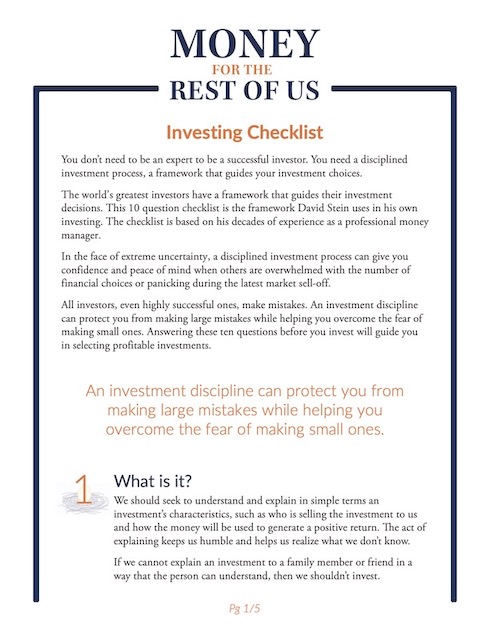
Become a Better Investor With Our Investing Checklist

Master successful investing with our Checklist and get expert weekly insights to help you build your wealth with confidence.

This site is protected by reCAPTCHA and the Google Privacy Policy and Terms of Service apply.

Transcript

Welcome to Money for the Rest of Us. This is a personal finance show on money, how it works, how to invest it, and how to live without worrying about it. I’m your host, David Stein. Today is episode 562. It’s titled, “How to Simplify Your Portfolio.”

Over the past couple weeks, we’ve been holding a retirement live portfolio workshop to a cohort as we work with 10 individuals who are newly retired and help them structure their investment portfolios and model out retirement outcomes. We’re using AI as part of the process.

Why Portfolios Feel Unsettled

In the discussions, because we meet a couple times a week for a total of around three hours per week, it’s become clear that a lot of these individuals, and individuals that we’ve worked with in the past, they feel unsettled about their investment portfolios. It’s almost as if they’re just not satisfied with them. And as I’ve tried to dig in more, it’s almost as if they have some standard that they’re holding themselves to, that isn’t really obtainable.

And as we kind of explore, “Well, what is that standard?”, or why do they feel that their portfolio isn’t simple enough, obviously, there is the concern as they get older, if they have a partner, or even as they age, that maybe they’re not gonna be able to handle the complexity of their portfolio. But it seems to be beyond that. It’s almost as if they— if you think about outfits, they just don’t like the outfit they’re wearing.

And the problem with investment portfolios is you just can’t change the outfit, because there are constraints. And the biggest constraint is taxes. If you have— and all of us, most of us have some type of taxable portfolio. If we sell those taxable holdings, we’ve held them a long time—we’ll have to realize a gain and pay capital gains tax on that. And so it isn’t as simple as just “Well, just get rid of everything and start anew.”

We have to realize that the portfolios that we have evolved over time. They’re based on reasonable decisions that we made over the years. And so—well, in some ways, it’s just like a wardrobe. Most of us don’t go out and buy a new set of clothes, an entirely new wardrobe every year. We might add a piece or two. Well, if you’re a typical American, you might add 50. But ideally, we’re not doing that. We’re buying fewer, better quality pieces, and adding them as time goes on.

Then some pieces wear out, or they just don’t fit anymore, and we’ll get rid of them. Our investment portfolios are the same way. We don’t have to get rid of everything, all at once. And usually, from an emotional standpoint, it’s better to do it incrementally. It’s easier to do it incrementally. Make changes little by little, as opportunities arise, as risks increase. And that’s how I’ve managed over the decades, both as an institutional portfolio manager, managing my own investment assets, and also as I educate individuals, like we’re doing in these live portfolio workshops.

A Five-Step Process

So let’s take a look at kind of the process that we’re going through with these 10 individuals, and I’ll bring you up to date as to where we are. Here’s the five-step process that we’ve been using. In reality, this is the same process that I use for institutional clients of ours. We would get a new client, and the first thing we would do is we would analyze their situations. They would send us box loads of bank statements, with all of their accounts, and then we would create a performance history, but we would also do an asset allocation.

What is the current mix among all their accounts? How much in stocks, how much in bonds, how much in private capital, and all the different asset classes? And that’s what we’ve been doing with this workshop.

Many individuals haven’t really looked at everything comprehensively—all of their Roth IRAs, their regular IRAs, their taxable accounts, their own, maybe their partners. And so they put it all together, we have an asset categorization spreadsheet that we’re using. And in many cases they used AI to help them break down and list out every single holding that they have, and which of 30 different asset categories does it fit into.

For each of those asset categories, we have an expected return, we have a volatility assumption, and we have correlation assumptions using modern portfolio theory. At the end of the day, all we’re trying to get is an understanding of what are the total investable assets and what’s the expected return, and what’s the volatility, as measured by standard deviation.

And as we’ve had discussions, it turns out standard deviation is not a terribly intuitive concept. But what we’re measuring is bad things. How far could a portfolio drop? A portfolio with a higher standard deviation potentially can lose more money than one with a lower standard deviation. And so we’re going through that process, that was step one.

As a Money For the Rest of Us Plus member, you are able to listen to the podcast in an ad-free format and have access to the written transcript for each week’s episode. For listeners with hearing or other impairments that would like access to transcripts please send an email to team@moneyfortherestofus.com Learn More About Plus Membership »

Ready to get serious about your investing?

Access professional-grade portfolio tools, training, and a community to help you stay on track, tune out the noise, and grow your wealth with confidence.

Learn How

Filed Under: Podcast Tagged With: asset location, IRA, retirement investing, retirement withdrawal rates, Roth IRA, simplicity

Contact | Team | Topic Index


Darby Creek Advisors LLC
P.O. Box 68544 • Tucson, AZ • 85737

Copyright © 2026 • Disclosures, Privacy Policy, and Cookie Policy • Site by Tempora

Manage Cookie Consent

We use cookies to optimize our website, marketing, and services. 

Functional Always active
The technical storage or access is strictly necessary for the legitimate purpose of enabling the use of a specific service explicitly requested by the subscriber or user, or for the sole purpose of carrying out the transmission of a communication over an electronic communications network.
Preferences
The technical storage or access is necessary for the legitimate purpose of storing preferences that are not requested by the subscriber or user.
Statistics
The technical storage or access that is used exclusively for statistical purposes. The technical storage or access that is used exclusively for anonymous statistical purposes. Without a subpoena, voluntary compliance on the part of your Internet Service Provider, or additional records from a third party, information stored or retrieved for this purpose alone cannot usually be used to identify you.
Marketing
The technical storage or access is required to create user profiles to send advertising, or to track the user on a website or across several websites for similar marketing purposes.
  • Manage options
  • Manage services
  • Manage {vendor_count} vendors
  • Read more about these purposes
View preferences
  • {title}
  • {title}
  • {title}
Manage Cookie Consent
We use cookies to optimize our website, marketing, and services. We never sell users' data.
Functional Always active
The technical storage or access is strictly necessary for the legitimate purpose of enabling the use of a specific service explicitly requested by the subscriber or user, or for the sole purpose of carrying out the transmission of a communication over an electronic communications network.
Preferences
The technical storage or access is necessary for the legitimate purpose of storing preferences that are not requested by the subscriber or user.
Statistics
The technical storage or access that is used exclusively for statistical purposes. The technical storage or access that is used exclusively for anonymous statistical purposes. Without a subpoena, voluntary compliance on the part of your Internet Service Provider, or additional records from a third party, information stored or retrieved for this purpose alone cannot usually be used to identify you.
Marketing
The technical storage or access is required to create user profiles to send advertising, or to track the user on a website or across several websites for similar marketing purposes.
  • Manage options
  • Manage services
  • Manage {vendor_count} vendors
  • Read more about these purposes
View preferences
  • {title}
  • {title}
  • {title}