Money for The Rest of Us

Investment help and financial guidance for the rest of us.

  • Podcast
  • Guides
        • Asset Classes

        • A Complete Guide to Investing in I Bonds and TIPS (2025)
        • A Complete Guide to Equity REIT Investing
        • A Complete Guide to Mortgage REIT Investing
        • A Complete Guide to Investing in Gold
        • A Complete Guide To Investing In Convertible Bonds
        • Investing in Bitcoin, Oil, and Volatility ETFs
        • Carbon Investing and its Effect on Climate Change
        • Farmland Investing
        • The Opportunity and Risk of Frontier Markets
        • Investment Vehicles

        • A Complete Guide to Investment Vehicles
        • How to Invest in Closed-End Funds
        • What Are SPACs and Should You Invest in Them?
        • Economics and Strategy

        • A Complete Guide to Understanding and Protecting Against Inflation
        • Why You Should Rebalance Your Portfolio
        • What Is Risk vs Uncertainty?
        • Tail Events and Tail Risk
        • Understanding Web3 Investing
        • General

        • David's Most Influential Books
        • Topic Index
        • Glossary
  • Model Portfolios
        • Model Portfolios

        • Ultra Conservative Model Portfolio
        • Conservative Model Portfolio
        • Moderate Model Portfolio
        • Moderately Aggressive Model Portfolio
        • Aggressive Model Portfolio
        • Role-Based Model Portfolio
        • Equity Model Portfolio
        • Income Model Portfolio
        • Fixed Income Model Portfolio
        • Implementation

        • Model Portfolio Overview and FAQ
        • Model Portfolio Example Video
        • How to Select and Implement a New Portfolio Mix
        • Determining Whether To Sell A Taxable Holding
        • Portfolio Rebalancing
        • Calculating Investment Performance
        • Portfolio Resources

        • David’s Current Portfolio
        • David's Portfolio Trades
        • Model Portfolios Performance and Risk
        • Model Portfolio Holding Explanations
        • Model Portfolio Changes
        • Model Portfolio Alternatives for UCITS, TSP, and Others
        • Example Index Mutual Funds and ETFs
  • Members
        • General Resources

        • Plus Member Home
        • Member - Getting Started Guide
        • Member Forums
        • Submit A Question to the Plus Podcast
        • Member Tools and Downloads
        • Analysis Tools

        • Current Investment Strategy Report
        • Plus Premium Podcast
        • Categorizing Your Portfolio Spreadsheet
        • Asset Allocation Model (Spreadsheet)
        • Retirement Planning Calculator
        • Retirement Spending Calculator
        • All Investment Conditions Reports
        • Courses

        • Asset Allocation and Portfolio Lessons
        • Investing in Closed-End Funds
  • Join
  • Log In
You are here: Home / Podcast / 532: Should Private Assets, Gold, and Crypto Be Investment Options in 401k and other Defined Contribution Plans?

532: Should Private Assets, Gold, and Crypto Be Investment Options in 401k and other Defined Contribution Plans?

July 23, 2025 by Camden Stein · Updated August 6, 2025

A new executive order could radically reshape retirement investing by allowing private equity, crypto, and gold in 401(k) plans. This episode examines the factors driving the demand for alternative assets in defined-contribution plans, the potential risks to everyday investors, and why fiduciary rules and financial literacy gaps still matter.

Gold lights with a caption that says 401 (k)

Show Notes

Trump Executive Order to Help Open Up 401(k)s to Private Markets by Miriam Gottfried, Dylan Tokar, and Matt Wirz—The Wall Street Journal

Donald Trump set to open US retirement market to crypto investments by Antoine Gara, Jamie John, and Stephanie Stacey—The Financial Times

U.S. Labor Department Allows Private Equity in 401(k) Plans by Chris Cumming—The Wall Street Journal

U.S. Department of Labor Supplement Statement on Private Equity in Defined Contribution Plan Designated Investment Alternatives—U.S. Department of Labor

State Street New TDF Includes Private Assets by PSCA Net Staff—PSCA

The Power of Private Markets by Robert Crothers et al.—BlackRock

UNITED STATES COURT OF APPEALS FOR THE NINTH CIRCUIT OPINION No. 22-16268

The Relentless Ask: Private Markets Are Eating the World by Michael Batnick—The Irrelevant Investor

Don’t Buy Into This Easy Fix for Stock-Market Craziness by Jason Zweig—The Wall Street Journal

The Private Equity Boom Is Leaving Midsize Players Behind by Preeti Singh and Laura Benitez—Bloomberg

401(k) Retirement Plans:Many Participants Do Not Understand Fee Information, but DOL Could Take Additional Steps to Help Them—U.S. Government Accountability Office

DEFINED CONTRIBUTION PLANS AND THE CHALLENGE OF FINANCIAL ILLITERACY by Jill E. Fisch, Annamaria Lusardi, and Andrea Hasler—Cornell

On Endowments and Unintended Consequences by Paul Kedrosky—Paul Kedrosky

Episode Sponsors

Asset Camp

Money for the Rest of Us Plus

Become a Better Investor With Our Investing Checklist
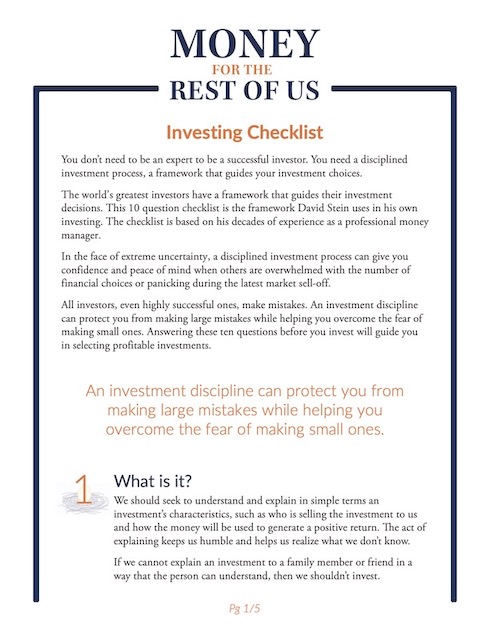
Become a Better Investor With Our Investing Checklist

Master successful investing with our Checklist and get expert weekly insights to help you build your wealth with confidence.

This site is protected by reCAPTCHA and the Google Privacy Policy and Terms of Service apply.

Related Episodes

509: How to Invest in Private Credit / Direct Lending?

497: How to Fix the Retirement Savings Crisis

490: Should You Invest in Private Equity?

Transcript

Welcome to Money for the Rest of Us. This is a personal finance show on money, how it works, how to invest it, and how to live without worrying about it. I’m your host, David Stein.

Today is episode 532. It’s titled, “Should Private Assets, Gold, and Crypto be Investment Options in 401k and Other Defined Contribution Plans?”

A Potential Executive Order to Allow More 401k Options

Last week, both the Wall Street Journal and Financial Times reported that President Trump is expected to sign an executive order in the coming days that would allow more private market investments in defined contribution plans in the U.S. 

The executive order is expected to direct the Labor Department and the Securities and Exchange Commission to provide guidance to employers and plan administrators as to how these type of private assets could be included. This could include private credit, private equity, leveraged buyout funds, venture capital, it could include gold, cryptocurrency. We’re not exactly sure.

The White House, in a statement released to the Financial Times, said President Trump is committed to restoring prosperity for everyday Americans and safeguarding their economic future. No decisions should be deemed official, however, unless they come from President Trump himself. Wall Street Journal and Financial Times are talking to people in the administration that are indicating this executive order is coming.

Now, the dollars at stake are huge. There’s $12.4 trillion in assets in U.S. defined contribution plans, including over $9 trillion in 401k plans. What’s interesting is right now, there actually isn’t any federal law that prohibits companies from including private equity in their 401k plans, but companies are worried about getting sued. In fact, Intel in 2015 was sued by one of its employees because Intel included private equity and hedge funds in their defined contribution plan. That was in 2015. 

Just this year, an appeal ruled against those employees that sued, saying that Intel didn’t breach ERISA, which is the Employment Retirement and Income Security Act. That’s the laws that 401k plans define, benefit pension plans operate under. 

And they have a fiduciary standard to act in the best interest of plan participants. And the court ruled that in this case, Intel acted as faithful fiduciaries, and that the plaintiffs didn’t prove that employees have been harmed by including these additional investment options. Yet, employers are still worried about being sued.

Existing Regulations for Private Capital in 401k Plans

In 2020, the Department of Labor issued additional guidance to plan sponsors that allows target date funds, which is in many cases the default option within 401k plans. A target date fund would be like a 2050 funds, for those planning on retiring in 2050. They can include private equity as one of the assets in these target date funds. And to me, that makes sense. 

These are diversified portfolios, they have a number of different assets in them. And to the extent that defined benefit pension plans have about 13% in private capital, it would make sense for a professionally managed target date fund to include additional diversification by allowing private equity and even private credit within those target date funds.

That’s very different than including a specific fund option that invests in gold within a 401k plan, or Bitcoin, or a venture capital fund within a 401k plan. That I don’t think is a good idea, and I’ll explain why in this episode.

Why Private Capital in Target Date Funds Makes Sense

This year, State Street Global Advisors launched a new target date fund. It’s called the State Street Target Retirement Index Plus Strategy. It includes traditional target date strategies, stocks, and bonds, but also includes some private investments managed by Apollo.  BlackRock also seems to be poised to provide target date funds in this area also.

One reason it makes sense to include private capital only within a target date fund structure is because of how illiquid private capital can be. My former advisory firm, FEG, we launched some private capital fund of funds. Our first one we launched in 2011. They’ve now launched seven funds. I’m invested in six of those. 

But if we consider those first two funds, the one launched in 2011, the other in 2014, it’s been 11 to 13 years later. And I look at my commitment—I’ve gotten out what I’ve put in, and the money I sent in in terms of capital calls, I’ve gotten that out. 

But if you look at the value remaining in the second fund, that value is still worth basically what I put in; a remaining value locked in the fund. And about half of what I put in the first fund still remains locked in the fund. And it will probably be several more years. So this is a 15-year type investment in private capital, and that’s why there’s something called the illiquidity premium. 

Ideally, one can earn a higher return in these private assets than they would in the public market because of the illiquidity. But I think this belongs within a target date fund, not allowing a private capital option within a 401k as a standalone fund option.

As a Money For the Rest of Us Plus member, you are able to listen to the podcast in an ad-free format and have access to the written transcript for each week’s episode. For listeners with hearing or other impairments that would like access to transcripts please send an email to team@moneyfortherestofus.com Learn More About Plus Membership »

Ready to get serious about your investing?

Access professional-grade portfolio tools, training, and a community to help you stay on track, tune out the noise, and grow your wealth with confidence.

Learn How

Filed Under: Podcast Tagged With: 401k, cryptocurrency, defined contribution plans, gold, private capital, private credit, private equity

Contact | Team | Topic Index


Darby Creek Advisors LLC
P.O. Box 68544 • Tucson, AZ • 85737

Copyright © 2025 • Disclosures, Privacy Policy, and Cookie Policy • Site by Tempora

Manage Cookie Consent

We use cookies to optimize our website, marketing, and services. 

Functional Always active
The technical storage or access is strictly necessary for the legitimate purpose of enabling the use of a specific service explicitly requested by the subscriber or user, or for the sole purpose of carrying out the transmission of a communication over an electronic communications network.
Preferences
The technical storage or access is necessary for the legitimate purpose of storing preferences that are not requested by the subscriber or user.
Statistics
The technical storage or access that is used exclusively for statistical purposes. The technical storage or access that is used exclusively for anonymous statistical purposes. Without a subpoena, voluntary compliance on the part of your Internet Service Provider, or additional records from a third party, information stored or retrieved for this purpose alone cannot usually be used to identify you.
Marketing
The technical storage or access is required to create user profiles to send advertising, or to track the user on a website or across several websites for similar marketing purposes.
  • Manage options
  • Manage services
  • Manage {vendor_count} vendors
  • Read more about these purposes
View preferences
  • {title}
  • {title}
  • {title}
Manage Cookie Consent
We use cookies to optimize our website, marketing, and services. We never sell users' data.
Functional Always active
The technical storage or access is strictly necessary for the legitimate purpose of enabling the use of a specific service explicitly requested by the subscriber or user, or for the sole purpose of carrying out the transmission of a communication over an electronic communications network.
Preferences
The technical storage or access is necessary for the legitimate purpose of storing preferences that are not requested by the subscriber or user.
Statistics
The technical storage or access that is used exclusively for statistical purposes. The technical storage or access that is used exclusively for anonymous statistical purposes. Without a subpoena, voluntary compliance on the part of your Internet Service Provider, or additional records from a third party, information stored or retrieved for this purpose alone cannot usually be used to identify you.
Marketing
The technical storage or access is required to create user profiles to send advertising, or to track the user on a website or across several websites for similar marketing purposes.
  • Manage options
  • Manage services
  • Manage {vendor_count} vendors
  • Read more about these purposes
View preferences
  • {title}
  • {title}
  • {title}