David converses with renowned illustrator and financial philosopher Carl Richards on the abstraction of money, attentional capital, distinguishing risk from uncertainty, and the importance of taking microactions.

Show Notes
Your Money: Reimagining Wealth in 97 Simple Sketches by Carl Richards
Episode Sponsors
Become a Better Investor With Our Investing Checklist
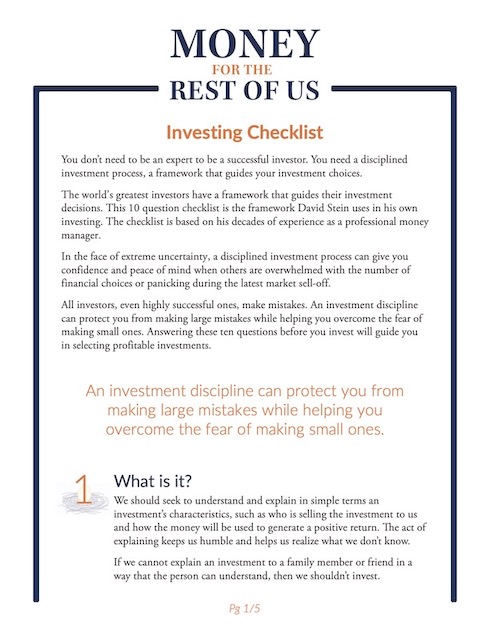
Become a Better Investor With Our Investing Checklist
Master successful investing with our Checklist and get expert weekly insights to help you build your wealth with confidence.
Related Episodes
496: Are You Taking Enough Aspirational Risk?
394: How to Get Better at Risk Taking
Transcript
Welcome to Money for the Rest of Us. This is a personal finance show on money, how it works, how to invest it, and how to live without worrying about it. I’m your host, David Stein. Today is episode 533. It’s titled “Money, Risk, and Uncertainty with Carl Richards.”
This week, we have a rare interview. This is only the second interview I’ve done this year. I’m conversing with Carl Richards, who I’ve known for a number of years. He’s best known as the sketch guy columnist in the New York Times. Very keen insights when it comes to financial concepts and putting them down as illustrations.
He’s also a certified financial planner. He built and sold a successful investment firm. His best-selling books include The Behavior Gap and The One-Page Financial Plan. His new book comes out in October. It’s Your Money: Reimagining Wealth in Simple Sketches.
It does have illustrations, but it also has some very keen insights. It was some of the topics in that book and his other writings that Carl and I discussed today, mainly how money is abstract, and how we deal with how abstract it is. The difference between risk and uncertainty, how we manage and navigate that, both in terms of our day-to-day life, as well as how we approach investing. We also talk about the benefit of doing nothing versus taking micro actions, as he calls them. I loved this conversation, and I hope that you enjoy it. Here’s Carl Richards.
David Stein: Well, Carl, thanks for being here.
Carl Richards: David, I’ve been looking forward to this for a long time, so I’m super excited about it.
David Stein: Yeah. So you have a book coming out, you’ve written a number of books. And in your writing, you’ve mentioned that money feels abstract, and it’s just numbers or digits moving through the ether, and it’s something that we often keep separate from our day-to-day life. And this is a theme I’ve covered on the show, I’ve written about, just because in some regard, money just seems unreal.
I mean, it’s a lot about cryptocurrency, and Bitcoin, and people think that seems so unreal, but when you realize that money, fiat currencies, that’s digits, mostly electronic, can be created out of thin air, it kind of blows the mind. So how has your understanding and relationship with money changed after many years in your work, your illustrations? How has it changed your concept over time?
Carl Richards: Yeah, that’s such a good question and a great place to start. I feel like—and maybe a story is helpful. Last summer I was at the farmer’s market here in our hometown, and there was a guy there that makes honey. I mean, he doesn’t make the honey, right? He harvests the honey. And I was telling him that I had a little bit of seasonal allergy, and he went through his seven different bottles of honey, and he found just the right one, and he handed me the honey, and then I handed him some money.
And that interaction, I actually thought about that interaction as I walked away. I thought about this idea of like—here’s a guy who spent some time and some energy, and probably some love on the honeybees, and had the honey, and it was clear that he cared deeply about the experience, because he literally like sort of shuffled through, found just the right honey for me.
And then I had something in exchange. I had something that I had traded some time and some energy, and money for. It was a little cleaner, in terms of its ability to trade, called money. And I handed it to him, and I walked away.
And I thought about that experience of looking someone in the eyes. And it feels to me we’ve gotten so far from that, right? Like, I was thinking about this other day—my grandpa probably knew his banker. It might have even been one of his neighbors or somebody in the neighborhood. My great-grandpa certainly did. I have no clue who’s on the other end of my mortgage.
David Stein: Oh, right. Yeah. I remember my mom, I remember a time when she decided—she didn’t have money enough for the mortgage, so she went to the banker and said, “I can’t make it this month.” “It’s fine. Make it up next month.” It’s like, now the mortgages aren’t even at the bank. I mean, they’re sold in bonds, or whatever, right?
Carl Richards: Yeah. So I think that rift, that separation between our use of capital and what’s important to us, and what’s important to those around us, that lack. I actually believe this sort of place that money’s become this thing over there, right? It’s so abstract, we don’t really even connect to it.
When we do connect to it, it’s mainly around shame or blame. I think until we reintegrate that a little bit, that it’s at the—I think it’s at the root of some of our biggest problems, because greed, fear, resource scarcity is at the root of some of our biggest problems. And at heart, money is linked to that stuff. So until we get reconnected with what money actually means.
I mean, what it really means—somewhere somebody is trading a piece of themselves for this thing we call money. I’m trading a piece of myself for this thing we call money, and we trade. Like, at its heart, there was an element of this cooperation and this sharing between neighbors, between friends, between groups, between people in a small group.
And we’ve gotten so disconnected from that that we’ve forgotten. I mean, we’ve almost forgotten what it means to—almost at that basic level we’ve forgotten what it means to be cooperative humans. I know that’s a pretty deep place to go in four minutes, but that’s how I think about this sort of abstract disconnection between us and our money.
As a Money For the Rest of Us Plus member, you are able to listen to the podcast in an ad-free format and have access to the written transcript for each week’s episode. For listeners with hearing or other impairments that would like access to transcripts please send an email to team@moneyfortherestofus.com Learn More About Plus Membership »
